Wednesday, August 12, 2020

From f295: This kind of discussion doesn’t happen on Facebook.

f295 was an international discussion forum begun and administered by Tom Persinger. Originally just about pinhole photography, it expanded into all kinds of alternative methods.  It was active from 2004 until 2015 but it remains on-line. Recently it disappeared from the web for a few days, and that prompted me to decide to reprise some of my favorites here at Pinholica, for backup if no other reason.

f295 would occasionally have long discussions about technical and aesthetic aspects of pinhole photography. They were often responses to photographs with questions that didn’t just relate to some technical aspect such as you see so often on Facebook.

Here’s one which is one of my favorite spontaneous writing experiences. 

I can’t reproduce the whole discussion because I’d have to get permission from everyone. I can link to it but unregistered users can’t see the pictures and you can’t register. I can describe it and I think I’m OK with reproducing the parts of the comment that unleashed my keyboard. It started with the post of a photograph without comment by long term member Igor Bryakilev. The picture is reproduced here with Igor’s permission. It was posted on June 12, 2012 with the cryptic title of 'l’hommage.'


He posted it at mid-morning in Russia. I was the first to comment at 7:44am Central Time

This is a really terrific composition. I can think of about ten different painters and photographers this could be l'hommage to. Forced to make a guess, I'd say Man Ray.

There were three more complimentary comments which involved how this elevated a randomly encountered ordinary moment into a beautiful, dramatic photograph.

Late in the evening another longer term member I only knew by his screen name “Kier” apologized for what might be a critical question but he sincerely wanted to learn what others saw in the picture. I read it early in the morning. It flipped some kind of switch in my head. I remember writing this sitting at work and posted it at 9:45am.

"What is great about these images? I don't understand this thread of modern photography to produce images of this sort (non-descript subject matter, flat lighting). And there's a lot of it these days. I just don't understand it"

I think you might have unleashed a hopefully not too pedantic monster. I haven't had this much fun thinking about art in a while. Sarah and I talked about it for about a half hour this morning.

I'm not sure I can justify "these images" but I have a lot of response to this image.

My comment yesterday had to do with composition. One of the popular memes reacting to the invention of photography was that if photography repeated reality so accurately, what was the value of painting. One defense was that the idea wasn't to make paintings of beautiful things, it was to make beautiful paintings. An extension of that idea recognized the fact that a painting wasn't reality, it was a 2D surface. The basic thing you have to work with is composition, so just stick the paint on there in a great arrangement and maybe provide a little surface detail and that's all you need to get an emotional reaction from the viewer. I think this is abstract expressionism. I always think of Mark Rothko as the ultimate of this concept. Alfred Stieglitz did a long series of pictures of clouds which I always interpreted as a desire to remove subjective response to the object of the photography using clouds not as symbolic representations of stormy weather or peaceful sunsets, but simply as close to abstract patterns as you could get and not abandon "photographic" quality. (You didn't want anyone to think you were trying to imitate a painting.)

One response Sarah had was "This is not a broom"

In my comment yesterday I said I thought it might be a Man Ray Tribute, but now I'm leaning more toward a child of Mondrian and Miro. Very few elements, straight line geometric elements with that crazy twist of what looks like painted quarter inch copper pipe or maybe some kind of coaxial cable.(Is the right hand wall really curved?)

But realistic portrayals of the real world are interesting as well. One of the values we all get hammered into us in photography class is the power of the illusion of depth. If you have to sum this up in one quip, as I did in a recent handout, it is to use directional lighting.

"flat lighting"

Whaddya mean flat lighting. This isn't flat - it's directional as hell. It's coming from, if he were standing there through what was probably a long exposure, over the photographer's right shoulder. It's diffuse as hell, probably an open door or a really big window, just what you'd expect to find occasionally in a stairwell between landings. I think there's also an electric light in about the same direction, putting a little reddish glow at the right. It provides depth in a lot of ways. The shade of the walls provides a gradient as you change the angle from the source. It casts the shadow of the broom handle. As the twisted pipe moves in and out of the shadow you can perceive it's three dimensionality. There's kind of a Minor White conversations with light quality about it.

And who says directional light is the only light you can have a conversation with. It always use to piss me off when students would whine "but it was a grey day" when I would criticize them for turning in a flat photograph.

Flat is negative print (and screen) value too and full range it's opposite, Igor's got that nailed. There's a pretty white highlight on the left wall's edge, and the floor and the broom bristles anchor the low end.

And there are other cues to depth independent of lighting. Theres a good bit of one point perspective, and a bit of the broom bristles go behind the wall so you know there's a passage to the left there. (It could be just a few inch indentation though)

And you don't need that much depth for your illusion. Aaron Siskind did it with a relief of about an eighth of an inch.

"non-descript subject matter"

Celebration of the ordinary has been as big a theme in art as the nude or heroic battle. I've quoted Fox Talbot on it here before. I've always thought you didn't have to go to Monument Valley to find something to photograph. As a matter of fact, the art in it is often pulling off stopping and doing what's necessary to capture something you just run into.

Harry Callahan's pictures from Chicago, Detroit and Providence exemplify this and it was taken to kind of extremes by Irving Penn's platinum prints of cigarettes. Again, the idea is to make a beautiful photograph, not a photograph of beautiful things.

And think of the symbolism! OK, that's a little dramatic. When thinking yesterday of what this could be a tribute to, instead of an artist, it may have been a tribute to a favorite relative or friend who was a custodian. Sarah thought of it as a metaphor for the constant need for cleaning, a variation on the theme of decay you so often see around here at f295.

Or it could be about all workers. If I started going on about that I'd probably go over the line into class warfare pretty quickly so I won't' even start.

This is all very interpretive, and I'm a little worried about how pedantic it is (I just saw Woody Allen's Midnight in Paris), but maybe that's what we want from a work of art, something to make us think while we're decorating our local environment.

Thanks a lot, Igor, this was fun.

The discussion went on for two pages. Most of the comments consisting of multiple paragraphs complimenting the quality of the photograph and the theme of ordinariness. It included Kier's thoughtful response to my essay and a defense of his disinterest by someone else. 

It was very civil with no flaming.


Friday, August 7, 2020

6x9cm Variable Cuboid full system upgrade


Curiously, in the midst of all this business with the small, square format Manic Expression Cube, I was working on expanding the 6x9cm Variable Cuboid System.

One thing that led up to this was that I had made three fronts for it. Two were stereo, which were kind of disappointing. The format was 6x4.5cm in vertical only, which is weird for me when using any rectangular format. The image sizes for the pairs were different enough to be distracting and needed to be fixed. After all the work in stereo this winter, it was plain that a separation of only 45mm between pinholes didn’t seem worth it.

So I had two ready made fronts and already had the pinholes. All I had to do was tear out the septum, pry off the stereo shutter and make a new one. One of them was at very-wide 30mm and one at middling 55mm. (The third front was a 70mm). I went with the rotating over-and-under shutters as on the 70mm. If I did do a vertical composition and didn’t have access to the rising pinhole it would drive me crazy. It’s actually not that hard to make.

For templates, I’ve always used regular copier paper on any printer I could get acccess to. During the pandemic, I didn’t have access to my normal sources. At the digital print shop that does our Christmas Cards, they've always told me their minimum order was one. So I had beautiful black templates printed on stiff 110 lb. card stock. Four tabloids and six letter sized sheets came to less than five bucks. They’re really nice to work with and make extra strong parts.

To round out the system on the heretical long end, I chose to make 135mm and 200mm fronts. 

I’ve made 6x6cm cameras at 100mm and 120mm. I picked 135mm just to be a little different in this range, partly because of the wider format and because this is such an iconic distance. Everybody’s first telephoto lens is a 135. 

I’ve been a little infatuated with the 200mm on the Variable Cuboid so I did one that size for this system as well. I also have to shout out to Camera Casino who supplied me with a sheet of chip board that they use for backing large format prints so I could make this huge box. It’s very nice not to have make seams and deal with pre-existing folds.

Another thing that led to this was fear of becoming too set in my ways. I’ve been really enjoying the square format for a few years and haven’t loaded a regular 35mm Populist since January. Can’t I deal with a rectangle? I’ve also been going a little nuts with the small format Manic Expression Cube lately. I’ve been doing some undisciplined things like taking more than one exposure of a subject. Is it just because small pictures are cheap? Am I falling into the digital photographers trap of not pre-visualizing and just blasting away? Am I not worthy of a sizable piece of film? I don’t have to use the vertical option if I don’t want to.

I took it over to Merrill School for a demo.

The 30mm front. .2mm Gilder electron microscope apertures. f150. Rising front pinhole.


The rest have hand-drilled pinholes.

The 55mm front. .3mm pinholes. f183. Rising front.


55mm front. Axial pinhole.


70mm front. .34mm pinholes. f205. Rising front.


135mm front. .43mm pinholes. f313. Rising front.


135mm front. Axial pinhole.


200mm front. .54mm pinholes. f370. Rising front.


200mm front. Axial pinhole.


The film is Lomography 100.

Thursday, July 23, 2020

Truck

I’ve thought of doing this for some time, but what got me finally going was seeing Light Tactical Vehicles belonging to police departments and the National Guard parked on city streets around the United States last month.

The eponymously named Oshkosh Corporation - previously Oshkosh Truck - is one of the city’s oldest and largest employers. It’s probably the biggest multi-national company in town. They started doing military vehicles in the 1970s. Oshkosh Defense, the military division of the company, occupies most of their presence here.

Locals refer to the company simply as Truck.

Osborn Avenue is a popular route to the highway shopping district because it's a mile long stretch without intersections right through the middle of the city. On the north side is a giant series of high power line towers and the back of the former National Guard Armory. On the other is a large berm crowned with vegetation and a chain link fence with an occasional "Authorized personnel only" sign.


In spots the growth is thinner. If you walk up the berm and hold your pinhole camera on the top of the fence, you can see that it's the Viking Quarry, a giant hole in the ground in the middle of the city. It's pretty invisible. I'll bet most people have no idea it's even there.


At the western edge is a gate through which you can see military vehicles being stored. I extended the tripod and got the camera set up a step or two away from the gate and then moved it just inside the gate enough to get the picture. I was surprised that there was a car with it’s lights on, sitting in the shadow of the tree but that also seemed kind of intriguing. Just as I was about to open the shutter, an SUV pulled in from behind me and another one I didn’t realize was there pulled out from behind the car with the lights on.


They pulled up next to each other, conferred for just a second, and then a guy got out of the new arrival. He came over and asked me what was going on here. I told him I was taking a photograph. I showed him my camera and explained about the blog. It was interesting to me that Truck had these lots of vehicles all over town. I gave him my card. He said “We’re asked to not take pictures of the military vehicles.” I’m pretty sure he phrased it that way. I pointed out these were all over the city and they even display them. He repeated the same statement.

He was very polite and seemed a little uncomfortable having to confront me. I thought about my white privilege as I rode away.

Just south of the airport is another large berm that extends both ways from the intersection.


Something like that has to affect water runoff management.


A quarter mile or so down Old Knapp Road, there’s a gap in the berm where it looks like there was a pre-existing storage shed. Behind it, more military vehicles are visible.


Inside the berm is a chain link fence and a variety of Oshkosh Defense trucks. They have a very diverse product line. I didn’t realize it until after I closed the shutter and he moved, but there was a guy working on the the light pole. I don’t think he noticed me.


The ungated entrance is down Highway N. It’s another quarry. Several very large dump trucks rumbled by while I was there.


If you step inside the berm and look to the right, you can see the trucks. Four Light Tactical Vehicles were lined up at a little guard house and roared by me as I packed up the tripod. They didn’t seem to pay any attention to my presence.


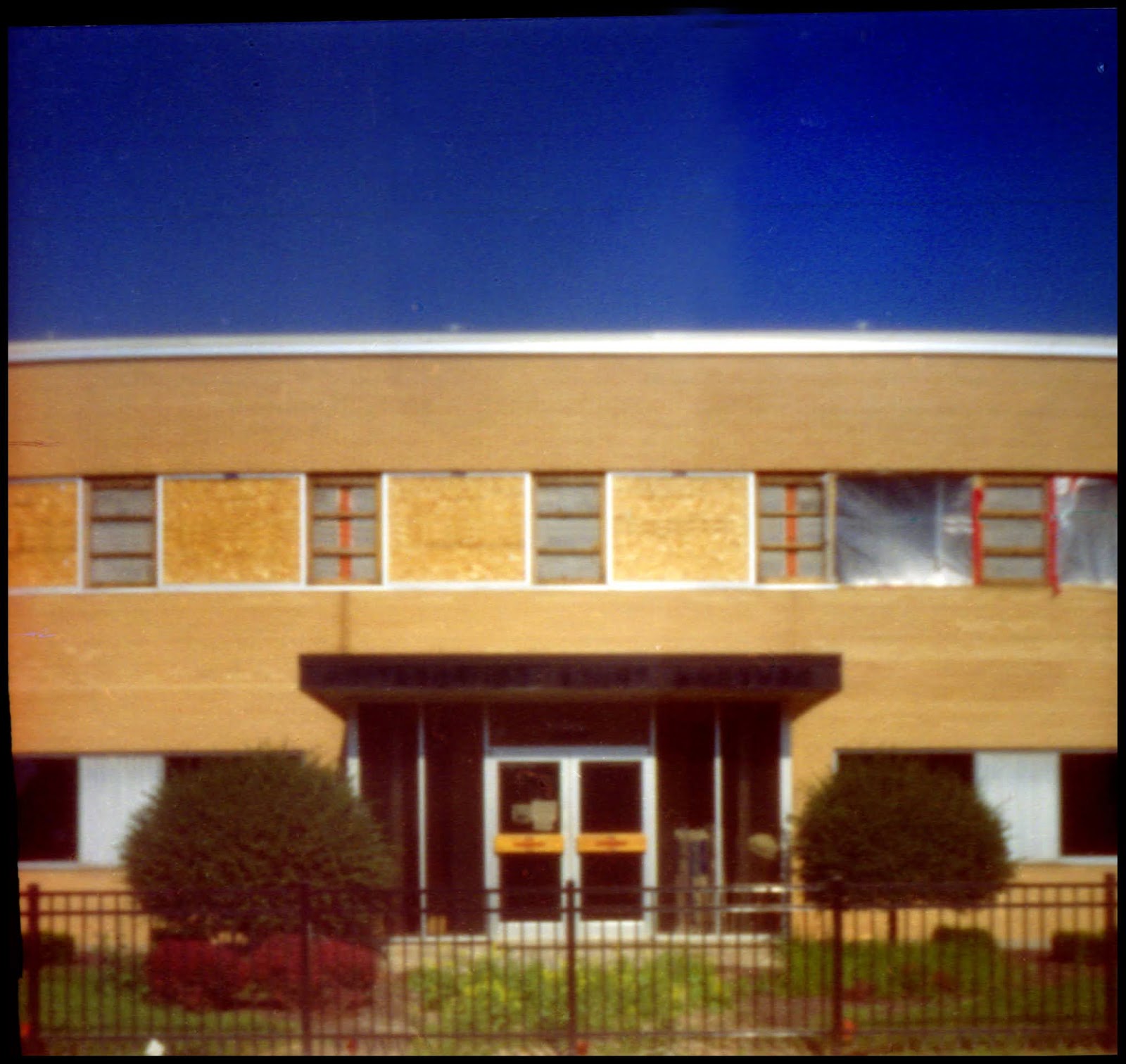
They have facilities all over town. I used to take my Renault 18i to get fixed in this building on the north side. I’m not sure if Truck no longer leases the building or if they’re just in the process of putting the new logo on it.


It used to be Nolte’s Garage, who also operated a towing service. This lot is the last place I saw our Datsun 210, totaled by a drunk, and our ‘90 Taurus wagon, totaled by a guy who just wasn’t paying attention.


Just across the road is the Harrison Street Plant. Leach Garbage Trucks were made here before they were bought by a Canadian conglomerate.


They’ve put a water feature in one corner of the parking lot.


The back half of the employee parking lot is fenced off and full of Light Tactical Vehicles. That’s kind of an ironic name - they weigh 5 tons. I held my tripod against a light pole to get a look over the fence.


I really didn’t need to be stealthy. This was on the Fourth of July. I could walk right up and point my camera through the gap in the gate hinges.


There’s another large lot to the west of the plant. The chain link fence has white plastic woven in it to obscure the view. I wonder what they’ve got back there?


This facility in the northwest industrial park usually has a vehicle parked out front like they’re proud of it. There’s not one there now. They just have a few trucks behind the building.


The original main plant is at the south end of town. There are four or five gigantic buildings scattered for three quarters of mile alongside the airport. It’s kind of hard to capture the scale of this place.


Most of what is in Oshkosh is Defense but Oshkosh Corporation has numerous divisions that make other kinds of utility vehicles. In the middle of the complex they also make cement truck mixing drums.


It’s quite a relief to see some deliberate color in the sea of khaki. I recently discovered they do the final assembly of these in a plant on the north side.


Just south of that the fence is woven with green slats.


I happened to go by on shipping day. Flatbed trucks were lined up for two blocks waiting their turn.


As I was standing there, a Light Tactical Vehicle came out of the plant and roared down the road past me. It is pretty common to see them driving around Oshkosh going between plants. I waited for a light with two of them downtown today. They always seem be roaring when they go past.


It was going down just a block to re-enter the factory. The driver was impatient and honking the horn, which sounded like a normal car.


They’ve got a facility in a strip mall just next to the plant. In the ‘80s when it was new, this was Roy’s Supermarket, an upscale we’ve-got-the-freshest-produce grocery store.


Until recently, the global headquarters had been in this nondescript office block stuck on the front of the plant. You can just barely see where they removed the name above the door.


Their new world headquarters is in a scenic setting along the shore of the Fox River where it widens into Lake Butte des Mortes. I’m pretty sure I’ve seen an increase in corporate jets landing from the north on Runway 18 so they can get a view of the new building from the air. It’s noticeably visible from the Highway 41 causeway.


The city sold them half of an under-utilized public golf course so they wouldn’t relocate to one of the half dozen other cities they have a major presence in. This wetland was the location of a sand trap on hole 7.


I’m trying to figure out the symbolism of the two-story temple-like relief set into the brick.


Some stairwells are appended to the side at an angle to break the stark rectangular structure. Most of it has a good view of the river. From certain angles you can see right through it.


They did re-landscape a lot of the golf course and maintained most of the mature trees, which include a lot of majestic native oaks.


One really good thing that came out of it was a sizable new public park. It includes a new trail from the Wiowash trail system back into the city so you don’t have to ride down the sidewalk of busy Oshkosh Ave. Yes, in Oshkosh, to get to the Oshkosh Corporation, you turn off the highway at Oshkosh Avenue.


I guess I’m willing to share a little of the shore line with them if they let me ride through it.


With the Manic Expression Cube. .17mm pinhole 24mm from 24x24mm frame. The film is Lomography 100 until the cement mixers. Then it’s Fujicolor 200.

Sunday, July 12, 2020

DC3/C47

Visible from the highway just south of Oshkosh is the Experimental Aircraft Association Museum. Parked out front where you can just walk up to it with a pinhole camera is a DC-3 in it’s 1942 C47 outfit. When I moved to Oshkosh, I worked with a soon-to-retire graphic artist who had flown over the hump in these during World War II. They were still used for passenger service in Eau Claire until after I graduated from high school.


You still see them flying over Oshkosh all the time. On the other side of the airport is Basler Turbo Conversions, who converts them to modern airplanes. Only 600 civil versions were ever built, but there were 10,000 of them made for the military during the war. The last new one was built in 1945. The Soviets built about half that many under license until 1950.


There’s quite a few parked in the field behind the plant. They recently discovered and restored the plane that led the paratrooper assault on D-Day in this lot.


Most are in some state of disassembly.


Quite a few of the originals remained in service around the globe into the 21st century


Usually they were used in some pretty remote places, such as this one from Boreal Airlines, now part of Nordair, which flies north from Quebec.


With the Manic Expression Cube. .17mm pinhole 24mm from 24x24mm frame. Lomography 100 film.