Sunday, January 26, 2020

Building a 45mm 6x6 stereo Populist

One of the things I enjoy about the Populist design is that it’s fairly easy to modify to different formats. I’ve extended it to longer distance to the pinhole, used wider formats, and made stereo cameras. Since I did the redesign last year, I hadn’t made a stereo version from the new template.

The 6x6cm format is particularly appropriate to stereo. Side by side chambers make the baseline between pinholes almost exactly the distance between human eyes. Most manufactured 35mm amateur stereo cameras like Kodak’s Realist had this separation, but made pairs on every third frame.


Poking around on the internet it looks to me like the most common angle of view (aka focal length for the refraction enthusiasts) for stereo cameras is the “normal” one of about 40 degrees which supposedly reproduces the perception of depth of human vision. In experiments I’ve done, angle of view is less important than the distance to the subject and the baseline. There have been couple pinhole cameras available for sale and, as is pretty common in pinhole, the angle of view is typically a little wider. I’ve done quite a bit of 6x6 pinhole at 60mm, so I decided I would see how it worked out at 45mm, about a 67 degree angle of view, which is very wide for stereo, but actually a little long in the pinhole world unless you make a camera yourself.

In order to make a Stereo Populist, take two templates for the camera length you want, and cut off the end for the film chambers on opposite sides.


Then glue them together on to the cardstock to make the camera body. This will eventually have to be done for the back as well.  Here's the two parts of the back template glued together.


Glue the two internal assemblies together.


Otherwise it’s just like making a regular Populist.  It does require two shutters.  I have used two separate shutters and connected them with a bar in previous stereo cameras. Since I was thinking of taking pictures of buildings, I wanted a rising pinhole, so I modified the shutter I made for the stereo fronts for the 6x9 Variable Cuboid for this camera’s longer baseline.


Since the divider between the two chambers is now in the middle, I decided to put the tripod mount external to the box in couple layers of foam core glued to the bottom. The counter shutter can remain in the same place and either one can be used, but you have to remember to advance two frames for every picture.

I did encounter a few problems and they may be related.

I painted the inside of the box and sides of the boxes where they slide together with some black satin finish interior latex paint. That may seem like a smooth surface, but when two of them are in contact, they don’t slide well at all.  I think it also may have absorbed in to the card and made things swell a little.  After the paint dryed, when I put the two boxes back together, it was almost impossible to get them apart. I eventually sanded off the paint on those surfaces.

If the take up reel isn’t parallel to the supply reel, eventually it will skew in one direction and completely jam up the film advance. I’m not sure if I hadn’t gotten it glued right or if the latex paint distorted it, but the take-up chamber was a little wider on the bottom. The film locked up before I even got to the first frame. I made a little spacer and taped it to the bottom of the divider and that did the trick. The film advanced very smoothly thereafter.


 I loaded and unloaded this roll of film three times and in addition to crumpled backing paper at the beginning, let’s just say it didn’t do it any good.

These are set up for Crosseyed viewing. It’s easy to learn with this simple exercise.

I also broke down and bought Anaglyph Workshop in case you have red/cyan glasses. I hope I got the alignment correct. Unlike crosseyed viewing where your brain and focus muscles do all the work, anaglyph does need alignment. It’s a hand made camera. OK? Every .16mm error from on-axis pinhole placement equals a degree on the image. The pinhole itself is only .3mm. The best thing I found is to adjust it until the image looks most monochrome. Viewed with your red/cyan glasses on, out of alignment they have an overall reddish or cyanish cast, like something you might correct with color balance. It gets sharper when it’s aligned too.

I thought the hydrangea would be a good subject.  I always forget how wide angle 45mm is on 6x6cm format and kept finding myself having to move closer to things to fill the frame. The nearest branches are about 4 feet (1.3m) and the garage is about 12 ft. (3m). Looking at the left side of the garage, I can see a definite separation from the distant trees.


Out in the street the near tree is maybe 30 ft. (10m) away and the much taller trees across the road are twice that. I can see the separation, but it’s not really dramatic. Stereo imaging is based on parallax, and a 166:1 (10m/6cm) triangle doesn’t look that much different than a 330:1 triangle. Everybody knows that wide angle cameras make things look farther away so you have to consider that in what your brain is trying to figure out.


The “Then and Now” exhibit at the Public Museum was part of the reason I’m doing this. A lot of pictures in the museum archive are stereoviews and the curator told me they had put stereoviewers and cards out in a previous exhibit and the public really liked looking at them.

One was of the Oshkosh Normal School which burned in 1896 and was replaced by Dempsey Hall. I expected to take this from the sidewalk but I had to trudge through the snow halfway to the building in order to get it to fill my frame. Stereo imaging is as much art as it is science. One of the tricks is to put something in the foreground so you get a real 3D wow effect.  I thought the trees would take this function. It’s a better trick if your foreground object overlaps your background object. If you look at the top of the entrance where it’s right next to the tree branches you sort of get that 3D wow effect. The pine trees are even closer to the camera, but since they don’t also overlap the building, you hardly notice.


The Dale School was our first home in Oshkosh. Again, I thought the trees and the low wall would give that dramatic depth, but again I was too far away. This was as close as I could get and keep the camera level and have the top of the building in the frame even with the rising front. Shoulda just gotten closer, pointed the camera up and lived with the converging verticals.


Probably the best of the lot, incorporating all these tricks are the chain link backstops in East Hall Field. Unfortunately, there’s no stereoview match for it in the museum archive.
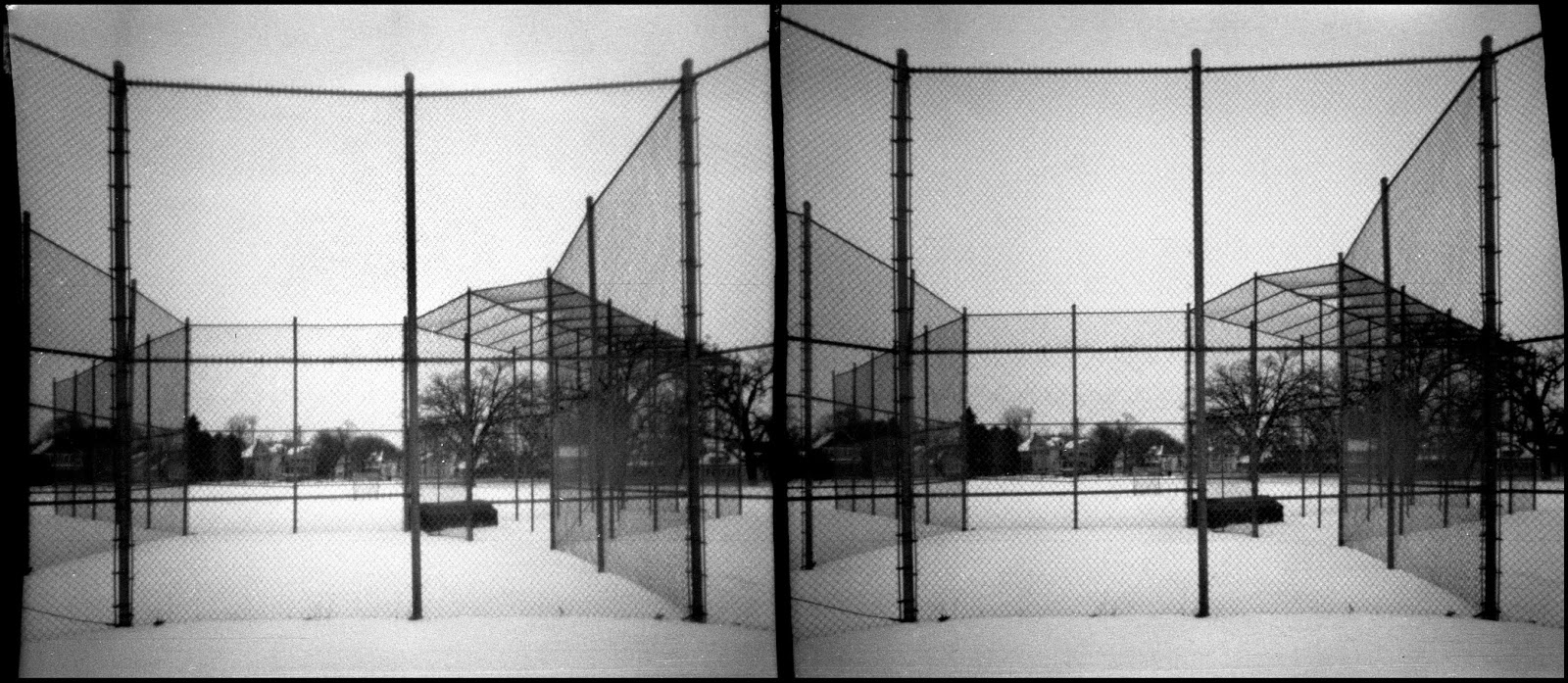


For this camera and for those similarly wide angle pinhole cameras on the internet, I’ll paraphrase Robert Capa: “If your stereo effect isn’t good enough, you’re not close enough.”

Tuesday, January 14, 2020

From f295: Lens Replacement

F295 was an international discussion forum begun and administered by Tom Persinger. Originally just about pinhole photography, it expanded into all kinds of alternative methods.  It was active from 2004 until 2015 but it remains on-line. Recently it disappeared from the web for a few days, and that prompted me to decide to reprise some of my favorites here at Pinholica, for backup if no other reason.


Andrew Bertram posted a picture of him giving blood on Facebook recently and wondered if anyone else had done any medical pinholes. I posted this on f295 on October 1, 2007.

For a few seconds last Friday, my right eye was lensless, but they did replace it with another lens. Here I am waiting in my gown, then all prepped for surgery and ready to go, and then waiting outside in the free fashionable sunglasses. Didn't have the courage to ask if I could bring the camera into surgery.


The Populist, .15mm pinhole 24mm from 24 x 36mm frame on ISO 200 film. Three minutes, two minutes, 4 seconds. 

Thursday, January 9, 2020

Adventures and misadventures with the Variable Cuboid.

For the Oshkosh Public Museum’s “Then and Now” exhibit, I really wanted to make a match for one of the archive pictures of a woman working at the Buckstaff Furniture factory. The site is now occupied by the Menomonie Nations Arena which hosts the Winter Farmers’ Market.

These apple sellers had a colorful display. I hadn’t noticed the distracting poster of the guy with the sword and the pizza behind them, and the round table cloth doesn’t do much for the composition.


I buy cheese from this lady nearly every week. All the boxes, blocks of cheese and tubs of spread make a better match for the belts and pulleys in the archival picture


These two were with the 45mm front for the Variable Cuboid.

When I made the new camera for the Building the Variable Cuboid post, I made a 100mm Front, which I hadn’t used yet. Better try it out.

In order to get any shadow detail when photographing holiday decorations, the lights often get really blown out. I exposed this for the time measured without the lights and turned them on for just the last minute.


I put a continuously adjustable rising front on the 100mm and tried it out on the just-a-bit-higher-than-my-tripod-will-go pothos above the bathtub. This is with the front at maximum rise. One nice thing about the long distance to the pinhole is there’s virtually no vignetting even this far off axis. The verticals did remain parallel.


While I was waiting for that exposure, this blue bottle with the shiny gold lettering on the dresser in the bedroom across the hall caught my eye, and I am a fan of close-ups. This is about a 1.5 to 1 macrophotograph.


I finally got around to going out with the 100mm while shopping for holiday gifts. While in the store where I’ve been buying jewelry for Sarah for years, I thought the room dividers and the counters formed an interesting composition. No one else was in the store so while they wrapped my package, I opened up the tripod and made this exposure.


And then, disaster!

I’ve been using the Variable Cuboid for almost a year now in all sorts of conditions. I’ve only seen one light leak when I rode around for about 50 miles on a couple bright sunny days with the camera on the tripod strapped to the rack on the back of my bicycle. Since that also included one time the camera jostled off the tripod and bounced down the highway, it didn’t seem like a problem. Now that I think about it, since then I’ve been careful to take the camera off the tripod and put it in my back pack while riding around. This time, however, I just carried it mounted on the tripod while I walked around downtown in the sunshine looking for something to photograph. This was also with the Lomo 800 in the camera, so it didn’t take as much stray light to cause mischief.  It appears that the sun can get down the light trap if given an opportunity, at least with this front.


The solution is more cardboard, of course.

On the top of the camera the front slides under the winders which keeps it in pretty good contact. The bottom is held tight by the tripod mount. On the sides where the pictures indicated it was vulnerable, I glued one double layer of cardboard on the film back just where the fronts stop, and then another which the front will slide under and deny Old Sol a chance to sneak down that way. It makes it a little bit fussier to change the fronts, but it’s still doable.


I hope it works.

Wednesday, January 1, 2020

From f295: On the fourth day he rested,

F295 was an international discussion forum begun and administered by Tom Persinger. Originally just about pinhole photography, it expanded into all kinds of alternative methods.  It was active from 2004 until 2015 but it remains on-line. Recently it disappeared from the web for a few days, and that prompted me to decide to reprise some of my favorites here at Pinholica, for backup if no other reason.

During the break between Christmas and New Year’s in 2007, I made five Populists to give as premiums for a contribution to support f295. I finished them and posted about it on New Years Eve. Every year on f295, there was a special forum for pictures done on New Year’s Day, kind of a members only version of Pinhole Day. I posted this under the title “On the fourth day he rested” on January 3rd, 2008

I have to say I had an enjoyable time working on getting a picture for the New Year's Day gallery. No braving the cold for me. I spent most of the day watching movies on TV and reading.

I really didn't even have to get up if I didn't want to.

Here are Sarah and I lounging in bed about 10:30. Cats coming and going thoughout the exposure.

The Stereo Populist. Set up for crossed eyes. About 10 minutes exposure

This is where the TV watching and reading took place. The chair which is enjoying the comfy environment with me is just to the left of the camera here.

The prints on the wall are from my earlier period in the late '70's-early '80's using an alternative optical scheme.

The Populist. about 10 minutes. 

Maybe this will make it more real for you.

The Stereo Populist, about 10 minutes, set up for crossed eye viewing. 

Here's a shot of the plants you can see both in the above photos and the New's Years Gallery photo during the brief period when the sun rose over the house next door and shone on the sun room windows.

The Populist, about three minutes exposure. 

I did have to compete with Spenser for this spot on the couch for a while, but he's as crazy as a Minnesota pinholer and kept going out on the back porch and coming back in all day.

The Populist. about 10 minutes.

Stewart is a much more sensible kitty and slept on a chair in the living room most of the day.

The Stereo Populist. Set up for crossed eye viewing. about ten minutes exposure. (He was really fast asleep, but he spends most afternoons that way.)

Even the ceramic kitties from the Metallica tableau in the kitchen were provided with a little extra comfort.

The Populist, about 10 minutes exposure.

And of course one has to eat.

The Populist, exposure as long as we spent having lunch.

I have been taking guitar lessons for past six months (and I'm only on page thirty-eight), so I did have to venture down stairs in the cold to practice.

The Populist. Exposed while playing scales and exercises and working on "Waltz in F"

All in all a pretty good day.

And in case you were wondering, here’s the photograph I submitted to the New Year’s Gallery.


Monday, December 23, 2019

From f295: League of Upper Midwest Pinholers; Eastern Division

F295 was an international discussion forum begun and administered by Tom Persinger. Originally just about pinhole photography, it expanded into all kinds of alternative methods.  It was active from 2004 until 2015 but it remains on-line. Recently it disappeared from the web for a few days, and that prompted me to decide to reprise some of my favorites here at Pinholica, for backup if no other reason. 

On Facebook today Ric Johnson posted a link to a ten-year-old story on a Twin Cities web site about a meeting of the League of Upper Midwest Pinholers, a group mostly consisting of folks from the Twin Cities, but which also included several members from other states including me by virtue of my attendance once at the invitation of Tom Miller who used to organize these events at the Minnesota Center for Photography.  (That’s how I got involved in Worldwide Pinhole Photography Day,) They continue to meet on an irregular basis, but for a few years it was always on the first weekend in November, usually announced on the f295 forum. I’ve only attended the one meeting but I always tried to take a picture relating to it on the day they met in Minneapolis.  On the day referred to in Ric’s post, I did this piece, posted on November 18, 2009 under the title: LUMP East.

Following a tradition of at least a couple of years, the Eastern Division of the League of Upper Midwest Pinholers mounted an expeditionary force to scale Mosquito Hill while the main body of the League was meeting in Minneapolis.

Beginning at the bottom of the North face.


Taking the official footograph was a bit of a challenge due to ground conditions at this time of year.


At the summit.


I don't think they perform this part of the ritual over there in Minneapolis.


And in recognition of the featured presentation by Marv Thompson and with a tip of the get well soon hat to Earl Johnson, here's a shot which includes a bridge.


All with the Populist. .15mm pinhole 24mm from 24x36mm frame.

Sunday, December 1, 2019

Reimagined interiors

We were given samples of photographs from the Museum Archives to be inspired by for the Reimagined Rephotographic exhibit, now titled “Then and Now.” There were many examples of interiors of businesses with the employees posing for the camera. I’ve rarely asked people to pose for my pinhole photographs and when I did they were participating in some sort of public event. Also in those cases the exposures were outside and only a few seconds long. Getting people to stay relatively stationary for interior exposures seemed like a big thing to ask for. 

Chatting about this to the curator organizing the exhibit, I mused that it might make it easier to get access to business interiors and getting people to pose for me if I start out with “I’m working on a project for the Oshkosh Public Museum. . .”  She said that sounded like fun. 

So one day I walked around downtown, measuring exposures and asking a few people if they would participate in a pinhole photograph. The response was pretty positive.

About a week later, I loaded the Variable Cuboid with Portra 400 and started my quest.

I began at Camera Casino. They’re naturally curious and encouraging about photography. They know me and my odd methods. I set up facing the main counter near the windows. One discovery is that everyone fills the windows with merchandise so they contribute very little to the interior illumination. I held my phone with the timer running near the camera so they had something to concentrate on and kept up a running conversation so they would appear somewhat natural (and of course, also somewhat blurred.)  During the exposure I learned that the guy on the left is the son of the owner.


My next stop was the Natural Foods store just down the block. One of the archival photographs was a grocery store on Main Street. I had originally intended to photograph the produce section in the next room, but when I entered from the back, I was taken by the vintage lamps and the tin ceiling contrasted with the modern arrangements of the supplements and herbal remedies. There was clerk behind the counter to the right, but she moved too much to appear on the negative.


One of the archival photographs was of a bike shop. Winnebago Bicycles took care of my old beater Timberlin for years and I bought my new bike there so I know them fairly well. The owner is the one in the foreground. That’s my bike on the repair stand behind him. He’s holding one of my new studded winter tires. It helps to be a customer.


These exposures in fairly well lit spaces were in the two to three minute range. I went into a couple other places and measured exposures that were twice as long. I had ordered some Lomography 800 and decided it would be worth while to wait for that to continue. When it came, I loaded it into the new Variable Cuboid back so I could use up the Portra where exposure time wasn’t an issue and use the Lomo to reduce the time people had to stay still.

A hardware store interior was included with the archive images, so I went to Kitz and Pfeil. There’s not an obvious owner or boss who could give permission to let their employees pose, so I just went ahead and tried to get a picture without asking. I set up with the camera back against a shelf where it was as out of the way as I could get it. Just before I opened the shutter, a customer asked me what I was doing. I explained about the Museum project and pinhole photography. He was a life-long resident of Oshkosh and kept me in conversation for quite a while. He had been standing right in front of the camera but eventually he moved to the side and I opened the shutter. One of the employees came by and I expected to be told I was right in front of something they needed to get at but instead she said she overheard us and loved pinhole photography. She asked me if I knew about some other pinholer whom she said created “real art.”


The patron told me that the building originally had been a JC Penney’s.  The stairs used to be an escalator. He loved to ride it when his parents had brought him there as a child.


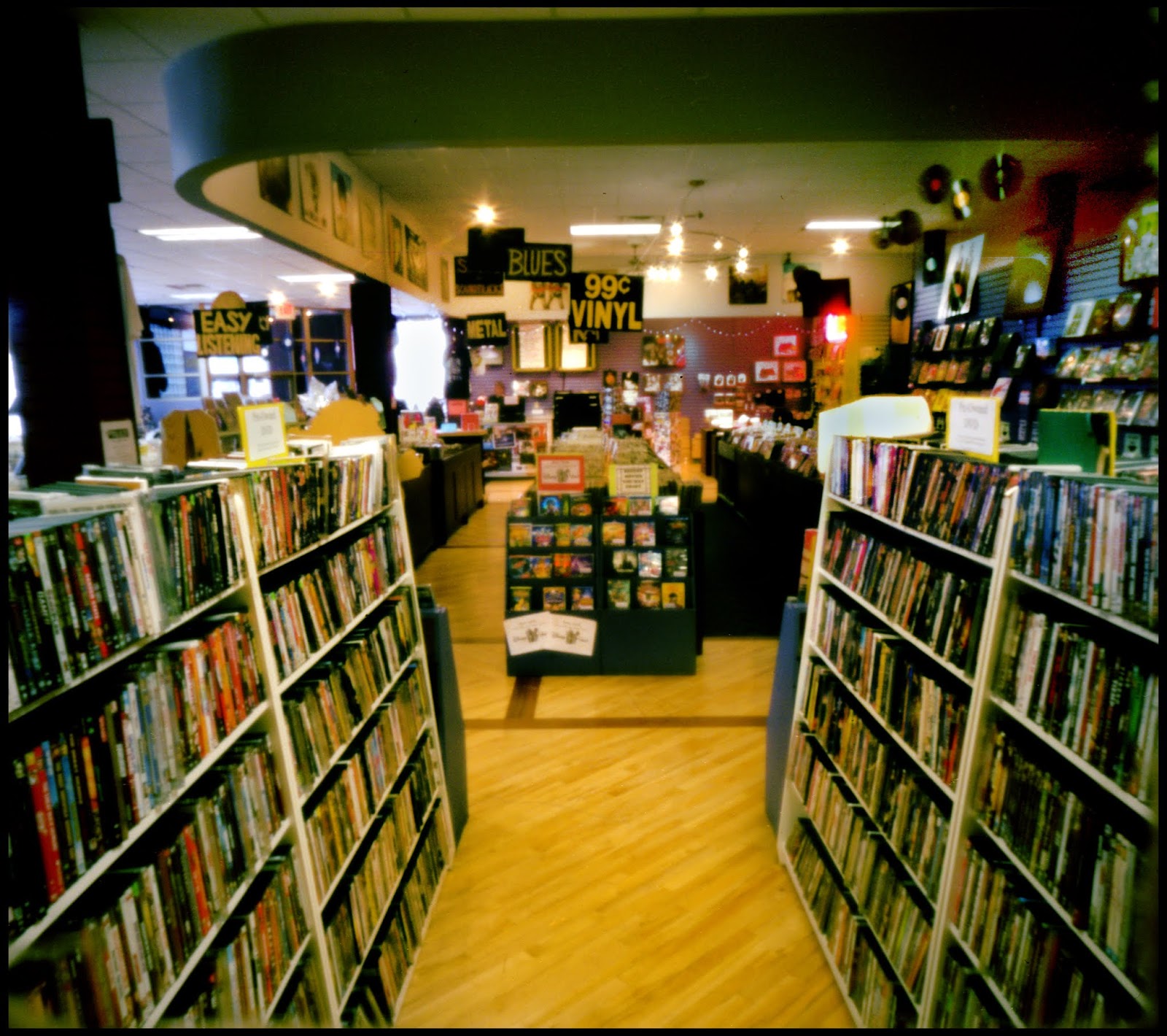
Mojo’s is a vintage video game, VHS tape and DVD store. I told all the people who agreed to be in my pictures that if a customer came in, they should just forget about my photograph and take care of business. This was about the darkest place I had to deal with and about a minute into the exposure a father with his little boy came into the store. It turned out it was the father who was looking to get games for his original NES system, which were in the locked cabinet right behind my camera. The clerk had to leave my composition and she deftly retrieved the items without bumping the tripod.


Satori Imports is in the former Spoo Brothers Clothing Store. There is the interior of a men’s clothing store in the archive, but it’s not specified which one. There’s also an exterior picture of one of the Spoo brothers when he was a young man working at the Continental Clothing Store. Satori offers a little bit different style clothing and accessories.


It was still early and some of the smaller shops downtown weren't open. I stopped to get coffee and a pastry at The New Moon Cafe which was originally Bauman’s Drug Store in the corner of the Beckwith House Hotel. The woman whose face you see on the left asked if it was a pinhole camera as soon as I put it on the tripod next to me. We conversed for a moment and I opened the shutter and sat down. Almost immediately she and her husband stood up to leave.  He's putting on his coat during most of the exposure. This was with the 35mm front.  People just don't realize how wide angle pinhole cameras can be.


Despite the wideness of the angle, I decided it needed the 20mm front to really take in the scene. It felt kind of odd with my hands in the changing bag in my lap under the table. I used to work with one of the women in the red coats at the University.  She was having an important meeting about the Oshkosh Food Co-op at the coffee shop.


Across the street is the First National Bank building. It’s cavernous lobby is featured in several images in the museum archive. All the offices around the perimeter are working businesses but they also use the space for events. During the exposure, two workers were setting up for weddings that evening and the next morning. They told me if I came back then the place would be really decked out and full of people. Everybody I dealt with seemed really proud of the place they were working.


There are at least four CBD stores in Oshkosh. Their presentation varies from just better than a bait shop to this one downtown, which is very neat and fashionable and reminiscent of a tourist attraction I visited once in Massachusetts. The clerk was a well dressed young woman, probably a college student. The cannisters on the table contain buds of what look exactly like the other type of cannabis, down to being labeled as indica or sativa. I asked her what people do with it. She said they make tea. It’s very relaxing.


Continuing down the block is another person I already knew, Jim Evans who owns the Art Haus, an art supply and framing store. Instead of a doorbell to announce customers’ entrance, he has a dog, who woofs casually to let him know someone’s there. It’s amazing that with the 20mm, I could get a full length portrait in the narrow aisle. Unfortunately it’s barely well exposed in the middle and barely there at the edges and it shows. I liked this angle because you can see some of the vintage cameras over his shoulder. He used to have 300 of them displayed, mostly folders, but he said he’s gotten disciplined and now has only about half that in the store. He’s been shooting 4x5 with a Speed Graphic lately.


A little unsure of myself with the 20mm in this situation, I also did one with the 35mm from another angle.


Several grocery stores on Main Street are in the archive. Today, in addition to the Natural Foods Store, there is Ski’s Meat Market, kind of a boutique grocery with lots of special brands. I was concerned about this point of view because of the east side of a cow facing west over the cheese display until Sarah told me farmers know that’s the end you have to take particular care of.


In the back is the butcher shop, frozen foods and produce with a very contemporary ceiling full of paper lanterns to soften the spot lights.


The Exclusive Company’s building was originally a Woolworth’s. The picture of the interior in the archive is a shot of a long hall with merchandise on either side. The closest I could come was from next to the back door in the electronics section. I thought it was funny to have a turntable in the foreground of my contemporary interpretation. How about that combination LED/incandescent/fluorescent/daylight illumination?


The front is the recorded music store, with the same kind of categorized bins we’ve been flipping through for years. As with the view from the back, it cracks me up that LP’s are the theme of one of the “now” photographs.


I had found out that a lot of the addresses I had been scouting of the exteriors of buildings were different from the ones in the museum archive descriptions. Prior to 1885, every builder did what they felt like but then the city enacted a uniform addressing code. The only way to find out where an older address is now is in a binder in the local history section of the Oshkosh Public Library. This is the dome in the original building with a big artificial tree underneath it waiting to be decorated.


That weekend was the holiday season kick-off for the indoor Winter Farmer’s Market, held in the lobby of the Menomonie Nations Arena. I went early to see if I could get some pictures. Santa was willing and there were no youngsters nearby. As soon as I opened the shutter, one of the volunteer photographers for the Market came up to me and began asking about pinhole photography. Despite the conversation going on in front of him, Santa held still for two minutes except for moving his right index finger.


The arena is on the site of the Buckstaff Furniture Factory which was in operation until 2010 and razed two years ago. I searched the archive before I went and found a picture of a woman working there amid a maze of belts and pulleys. I thought the contrast of people selling vegetables and handcrafts in the same location might be interesting. I’ve since gone back to get a closer view of some of the vendors.


This was all a little bit out of my comfort zone so I was getting impatient to get the film developed. Since I was going there anyway I took along the Cuboid kit to the Public Museum. I got there about 10 minutes before they opened. The estate was given to the city specifically for the Museum in 1922. One of the archive images is of the Grand Staircase. This was the morning after the Museum Auxiliary Gala. The exposure was going to be about 20 minutes. I opened the shutter and ran upstairs to let them know where I was and ran back down to babysit the camera. At least two staff members passed it while I was gone but they both assumed it was something I was doing.


One of the other pictures was of the library, now the venue for most of the public events and lectures.


I find myself with an embarrassment of riches with too many pictures. There’s five photographers involved and the gallery is not all that big. I’m going to have to do some gleaning before submitting archive/contemporary pairs for the exhibition.

I think they might have unleashed a monster.There are lot’s of places around downtown I want to photograph and my reluctance to ask people for cooperation seems unwarranted. In three cases, I had offers to go into parts of buildings the public normally doesn’t have access to.