Saturday, April 16, 2016

Why I love Worldwide Pinhole Photography Day.

We love to celebrate holidays at our house.  We go to the fireworks on the Fourth of July, carve numerous jack-o-lanterns at Halloween, just go nuts at Christmas, make pies on March 14, and spaghetti and meatballs on Talk Like a Pirate Day.

So Worldwide Pinhole Photography Day is another reason to have a special celebration.

It sometimes seems like Pinhole Day is kind of a funny little relic of an earlier time on the internet.  I mean, the idea grew out of a post on an email list serv. The role of the Dude's rug is taken by the on-line gallery of photographs, one per participant, all taken on the same day. It was not common to be able to post photographs at all in 2001 when this started, so just sharing your work with other Pinholers was kind of a special thing.  The only rules are it must be a lensless photograph, and it has to be taken on the last Sunday in April.  This sometimes seems like a really silly criterion.  There are now millions of ways to get your work on the internet, so this restriction to one day really focuses the mission of the gallery.  I grew up when instant world-wide communication was not available to regular people.  If you had contact with someone across the globe, it was either by an expensive telegram, an very expensive telephone call, or a very slow letter. It was really special.  So this coordination of behavior of people all over the world on one day still gets to me.

The other major function of the Pinhole Day web site is to list a variety of events which people organize in preparation of, or on Pinhole Day. I have never participated in a group activity on Pinhole Day, but I have done workshops at other times of the year and they're really fun.  I like the idea that Pinhole Day gives people the excuse to set up events, especially ones that give people their first experience of pinhole photography, and in a lot of cases their only experience ever of photographic chemistry in a darkroom.  I get kind of a negative reaction when people talk about "promoting the hobby," but I get a kick out of the idea of others experiencing something I think is pretty cool. Particularly exciting are the thought of this going on in school settings.  Pinhole Photography meets a lot of learning objectives (can you tell where I spent my career) in Art, History, Math, Optics, Physics, Chemistry and Manual Skills.  Kids tend to do things together so it's collaborative. It's naturally active learning, and then the cherry on top, it's really fun.

I have fun doing it. I get off on having to come up with a great photograph on that one day.  Cold, dark and rainy? Too bad.  Shoot interiors or use an umbrella. Not inspired? Tough.  Go find something to photograph. It's got to be today.  And then, you have to pick one.  Which of these photographs do you really like?  This all gives the whole thing a bit of an adrenaline rush.  But it's not competitive at all.  Everybody gets to submit one photograph.

I also tend to pull out old cameras for the day or occasionally build a new one. Variety is the spice of pinhole, I guess.

Full disclosure - I've been on the coordinating team (of at most seven people) since about 2005.  I'm the support coordinator (I answer the emails) and now I'm coordinator coordinator, too. We review every photograph before it goes in to the gallery (People can be really weird on the internet.) It's always amazing to watch the gallery build and see the crazy variety of cameras that people use, and as noted earlier, that gallery ties the whole thing together.

I've submitted a photo in every gallery since the first one in 2001. I've got plans for several different cameras I made years ago, which I recently refurbished a little.

It's April 24th this year.  The website is Pinholeday.org .  You can list an event or put a group on the list on the form so you can sort your images together with your friends at http://pinholeday.org/events/?pid=addEvent .  The submission form for Pinhole Day images will become available on the home page on April 24th (make sure it's after midnight in your time zone), and stays available until the end of May to give you plenty of time to process your work. (Don't dawdle, it closes on an automated script, so if you miss it, it would take a lot of work to restart things).

This year the event is dedicated to Gregg Kemp who created and managed the web site until shortly before he passed away earlier this year. His contribution cannot be over stated.

I hope you have fun on Worldwide Pinhole Photography Day.  But you've been warned.  You could fall in love.

My submission to the first Worldwide Pinhole Photography Day in 2001.


Tuesday, April 5, 2016

Total Knee Replacement Surgery

I recently went into the shop and had some parts replaced. My only previous experience with this sort of thing was having a lens replaced in my eye, and if I my vision hadn't been noticeably better, wouldn't known anything happened while I had a nap at the hospital.

This was a little different. I mentioned in my last post that my lower extremeties had been dominating my life lately.  Here's why.

The culprit.


According to the X-rays, both knees are really shot. Doctor picked the left one to go first, but in the two weeks before surgery when you're not allowed to take anti-inflammatory drugs, it became became pretty obvious this one was the choice for renovation. (They won't do both at the same time).

Pre-admission testing is one week prior to surgery.  First thing they put you into a room by yourself and roll a video of a nice little lady standing in a hallway talking to the doctor (Why don't they let this woman with bad knees sit down? Doesn't the doctor have an office?) explaining some of the necessity, benefits and risks (Haven't I already agreed to this?), and a little about the surgery and recovery.


I've been doing the pre-op exercises every other day for about eight weeks.  They consist of several isometric exercises.


Some dynamic exercises.


and some that combine both.


You have to arrive at the hospital at 5:30 am.  They do six of these a day and don't tell you what order you're in until you get there, but they get you prepped right away.  My turn was pretty early at 9:00, but that still left several hours to wait.


The only thing they really attach before going to the OR is the all important IV (Does anyone else hear "Sister Morphine" while looking at this picture?)


The surgical leg about an hour after surgery. The leg is strapped into a CPM machine that flexes and straightens it on about a five minute cycle.  For the first day I also have attached the aforementioned IV, now with fluids, antibiotics and a self-administered (but limited and closely monitored) morphine injector, a femoral nerve block, surgical site drainage bag, pulse monitor, respiration and gas exchange monitor, catheter and a pulsing cuff on each ankle to help circulate blood out of my feet that feels oddly like a cat walking over my leg when they start a cycle.


Later in the afternoon, with all this stuff attached, they get you to stand up on a walker, take two steps and strap you to a chair sitting up.


Dinner the first night is clear fluids - apple juice, jello, and chicken broth, but to be honest, all this sort of spoils your appetite.


They remove most of this stuff the second day including the femoral block, which has rendered the leg pretty numb and immobile, and the morphine injector.  They switch you to two Vicodin every four hours (if you think you need it. Ha, ha, ha). The Vicodin reduces the pain quite a bit but doesn't really eliminate it right away. The hospital really isn't a great place to sleep in any event. Here's a picture of the flowers my son sent silhouetted against the glow of the monitor lights of the CPM machine and the circulation cuffs, and the fully lit hallway from 2 to 6 am.


Made all the benchmarks to be checked out as scheduled on the third day.  After the occupational therapy guy taught me how to get dressed, I still had to wait a couple more hours to be released.


Sent home with a few little helpers. A common bit of advice from others who had experienced this was to "stay ahead of the pain". The lead story on the local news the night I had surgery was about the dangers of addiction to painkillers.


Bed rest is specified for most of the day the first few weeks.  The bedroom and bathroom in our house is on the second floor, so once I got up the stairs with much difficulty,  I was pretty much confined up there.  The helpful little manual they send you home with warns you that you might be a little more tired than usual.


Sarah did a great job of making it homey. We had meals at a little table she set up in the bedroom. It only turned out to be two days before I could get down and back up the stairs for meals.


You still have to do exercises -  fewer, but more often.  Everybody warned me how important these were.


You're only supposed to get up for thirty or forty minutes at a time.  Sarah brought the Telecaster up stairs. Luckily no problem sitting with a guitar.  Here I'm playing "Sister Morphine" to mark the occasion.


The bed rest is to prevent swelling.


The incision was looking good a week post-op.


Part of recovery is professional physical therapy three times a week.  A big revelation was that most of what you're recovering from is the damage they do to the muscles and tendons in order to fix the knee.


Almost all physical therapy locations are part of retirement homes and care centers. It was kind of odd to be a fairly healthy guy doing exercises among the rest of the patients who had much more severe problems. (Note the double duty of the walker as a camera support.)


It worked though.  I made the flexibilty measurements for a healthy knee by the second week (although nowhere near the muscle strength). I graduated from the walker to a cane by about two weeks.


I had my follow-up appointment yesterday morning and everything is doing fine.

All with the Populist. .15mm pinhole 24mm from 24x36mm frame.

Friday, March 25, 2016

Pinhole Footography

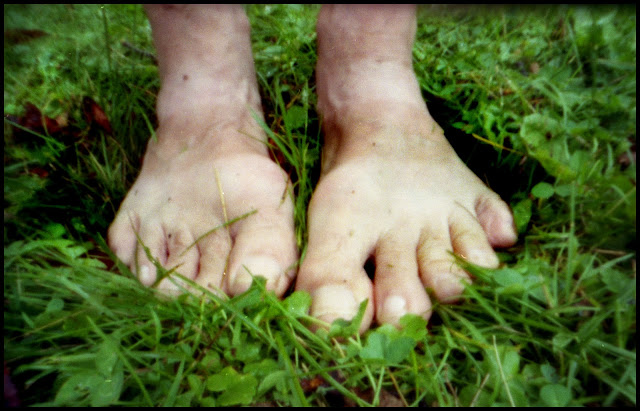
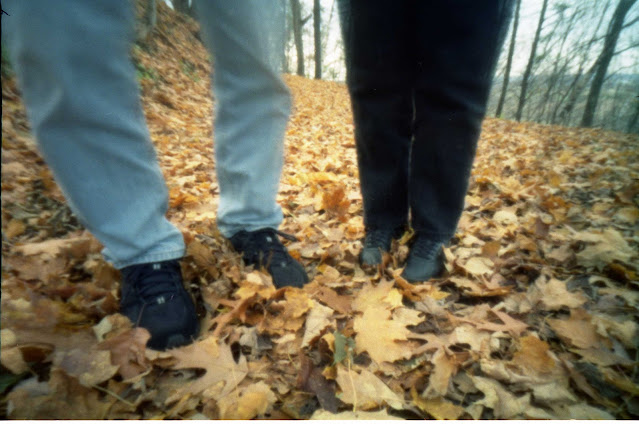
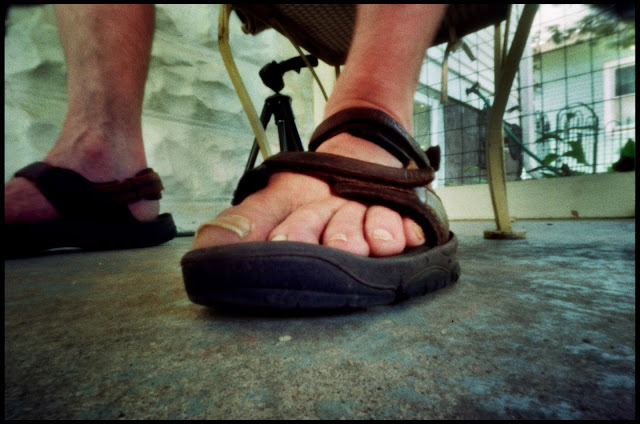
Everybody loves a pun and lately, my lower extremities have been dominating my life. Also, it's a particularly pinholey topic.  One common experience of the beginning pinholer is that often the camera has no tripod mount, but in order to take long exposures, it needs to be well supported and the ground is the most convenient place to do that.  Combine that with the advantage of filling the frame with something and one's feet become an almost inevitable subject.

I've also always had a bit of an issue with my feet.  When major universities were competing to give my basketball star older brother a scholarship, John Erickson, head coach of the Wisconsin Badgers came to our house to recruit him.  At the time I was about 5' 4" and had the same size 13 (46 in Europe) feet I have now.  He called me "Feets." He ran for the Senate in 1970.  It made my first experience casting a ballot that much better to be able to vote against him.  (He lost.)

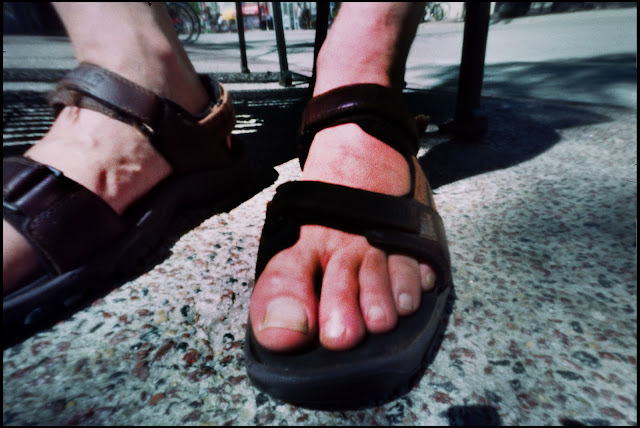
The call for submissions forum on f295 had a Portraits topic one year.  I had just taken this photograph of the distinctive tan pattern of my sandals which I thought captured my essence pretty well.


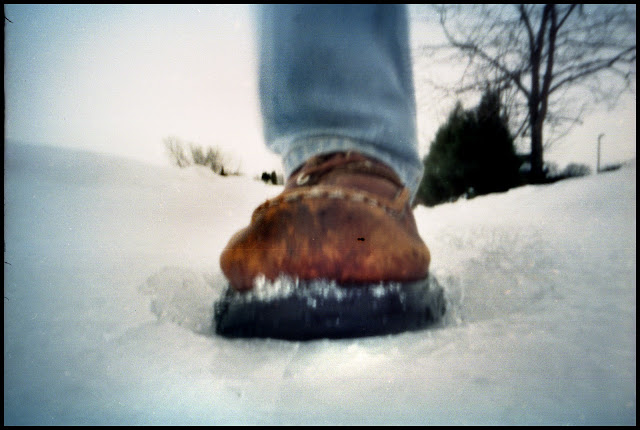
One winter we had a series of thawing and refreezing days and I was impressed by the way the ice cracked under my feet as a I walked to Walgreens to get some film developed.


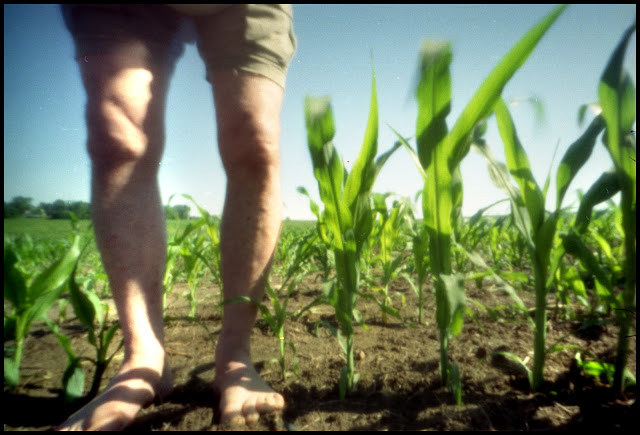
Some times you need some sort of a scale object to demonstrate the size of something as with this assessment of agricultural progress done on June 30th one year.


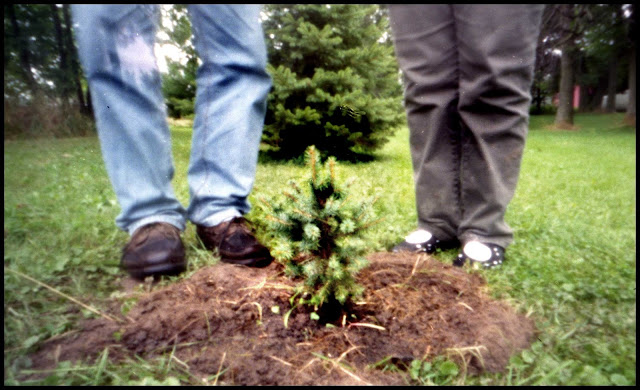
My son attended a wedding where they gave a spruce seedling to all the guests.  After about a year we finally got around to planting it at Sarah's family farm.


One summer I experienced a very painful episode of gout, the famous medieval affliction, while we were on a getaway weekend in Madison with friends.


Occasionally, ground conditions make it difficult to get a good footograph.


One thing that always irritates me a little as a reviewer for Worldwide Pinhole Photography Day is how many photographs are submitted with the camera sitting directly on the ground with the pavement of the town square filling most of the frame, so I took this picture inspired by those folks.  If you're running a workshop for pinhole day this year where your participants will be putting the camera on the ground, you might suggest footography.


All with the Populist.  .15mm pinhole 24mm from 24x36mm frame.

Tuesday, March 22, 2016

The Populist: a derivative.

I should preface this post with this cartoon which appeared in an issue of the CoEvolution Quarterly, a magazine published from 1974 to 1985, founded by Stewart Brand of the Whole Earth Catalog. This cartoon has been displayed somewhere in our house ever since (Hand colored by Sarah)


Shortly after I posted the directions for the Populist on-line, an editor from Barnes and Noble sent a message to Gregg Kemp's Pinhole Visions email list indicating that they were thinking of producing a package with a book on Pinhole Photography that included a kit with everything you needed to make a pinhole camera, and could anyone recommend a paper engineer to help them out.

I responded that I was certainly no paper engineer (if you follow this blog you know just how funny that idea is), but just to get some idea of the kind of thing that was available for free on-line, sent them the link to the Populist

Much to my surprise, she responded several months later and asked if I would like to be involved in the project. I was concerned that if I did, I would have to take down the on-line version, which would have been philosophically distasteful  (after all, it is a camera anyone can make). Her response was that the populations who might buy a kit browsing in a Barnes & Noble and those downloading plans on the internet didn't overlap very much. And they offered me money for it.  Not enough to retire on, but enough to make Christmas a lot more fun that year. 

They just wanted the rights to use the design but they'd like me to kibbitz on what they did with it. We worked together on and off for about six months.

It came out in time for the 2009 holiday season as Create your own pinhole camera bundled with the  book Adventures with pinhole and home made cameras by John Evans which they had previously published in 2003. The book is pretty comprehensive and well done, but it's kind of obvious that the kit and book weren't done as an integrated piece. I'm not credited anywhere, nor is the Populist mentioned as the basis for the camera.


It's still available on-line for $16.99.  It's got eight reviews with an average rating of 3.9 so it must work, although one of the reviews criticizes the recommendations for exposure.


The directions booklet follows the outline for the Populist pretty well, but all the photographs were redone with the materials from the kit of course, and the text rewritten by a professional copywriter. There's still a little bit of my text in there.  It's really pretty well done.


The camera you see in the photo at the top of this post isn't made from the kit.  They sent me a proof printed on the final material before they made the final dies to cut it out, so I had to cut the parts out with an X-acto knife. It all went together all right and no changes were necessary in the final product. They didn't include any pinholes, and I never exposed any film in it.  I've never put together the final product they sent me,

There are some changes from the original Populist design. They didn't like the idea of the corners being taped because they wanted it to look like a real camera. The box is held together with glueing flaps. I had considered that for the Populist, but I was concerned about the corners being light tight, and if you were going to cover them with opaque tape, the flaps weren't necessary to hold the box together. They did include a roll of black tape and the directions indicate to use it in the internal box, but the tape is no where near opaque.  Since the film in the side chambers is enclosed in a cassette, I've often wondered if the opaque tape was necessary on the corners and have been meaning to make a camera with clear tape to find out. Since no reviews said anything  about light leaks, it's probably not a problem.

Another change was the addition of a second winder and the placement of the rewind hole on the top.  In the original Populist, I thought making a second winder was an unnecessary hassle, and I put the rewind hole on the bottom so it would rewind in the same direction as for winding and suggested just inserting a piece of card stock between the two boxes to cover it except when rewinding. 

One change they made that I'm not too thrilled with was the addition of a frame at the top of the shutter to act as a handle, and as the viewfinder.  On the Populist I include viewfinding triangles to go on the top and sides of the camera.

To be honest, if you put your eye up to the back of a camera as you would with an SLR, it does include just about what the camera will capture.  In this day of people viewfinding through phones and LCD panels on the back of the camera I don't think a lot of people will be doing that.  And if you think of the common ways this camera is going to be supported, sitting on some table or bench, maybe supported by a tabletop tripod, getting your head in the right place is going to be nearly impossible. I'm also a big fan of closeups and this is also going to introduce a fair amount of parallax error if you do look through it. It's kind of floppy and I don't think it would survive many trips in and out of a pocket, and (this is one of those times that sound more like a religious argument) its not very pinholey.

They wanted to include two sizes of pinhole and a blank piece of brass to drill your own pinhole.  In order to accommodate that, I suggested a new part to attach the pinhole to which snugly slides inside the exposure chamber with folded flaps that held the pinhole tightly in the front of the camera.

The pinholes they included are supposed to be .2 and .15mm and look to be fairly close so I'm not sure about the criticism in one review that exposures in bright sun required minutes rather than seconds. They appear to be drilled either with a laser or an electric spark. Until I started writing this post, I had never gotten them out and looked at them. I hate to say this, but they're really terrible pinholes. They appear to be roughly the right size, but they both have really ragged edges. The larger one seems to have a raised blister around it, and the smaller one is more semicircular than round. Almost anyone with the least bit of care could drill a better pinhole. I suppose to be fair, I should put them in a camera and try them out.

When it was first released my son saw it on a shelf in a Barnes and Noble in Boston, but otherwise I've never seen any mention of anyone using it, and never seen one mentioned in a post to the Worldwide Pinhole Photography Day gallery.  About a year after it was released, I asked how it was doing and they said it was OK.  It's sales rank on Barnes and Noble is 93,217, but they sell a lot of books so that doesn't really mean anything.

Last year I was sent a request to put a link on the Pinhole Day site resources page from someone in Italy and was surprised to see the camera featured on the home page, so I guess it's gotten around.

If anybody has used one, I'd be curious to hear about it.

I've always been a little perplexed by the design on the front, but recently realized it was a stylized version of looking straight on to a bellows folder.  You know, a real camera.

Tuesday, March 8, 2016

Roadtrip: The Museum of Wisconsin Art

I've never been to West Bend.  When I moved to Wisconsin and told people we came from South Bend, Indiana everyone misremembered it as West Bend. We saw a segment on a Wisconsin tourism show that featured the Museum of Wisconsin Art, which we had never heard of and looked cooler than I would have expected, although Wisconsin does boast some pretty heavy hitters – Georgia O'Keefe, Edward Steichen and Frank Lloyd Wright.  Among pinhole notables, Ruth Thorne Thomsen is from Door County. (later edit: I was wrong about that but she did do work there.)

Sarah needed to replace some specialized light bulbs so we stopped at the Kristopher Kringle Shoppe since it was right on the way in Fond du Lac.


It's crammed with decorated Christmas trees and every sort of collectible figurine or miniature village you can think of.  Surprisingly cheering on a bleak, windy February morning.


Six rooms full of the stuff on two floors.


West Bend has several really interesting sounding restaurants, but they're all open only for dinner, so for lunch you're left with the chains out by Highway 45, or the bars downtown.  You can't go too wrong by picking a microbrewery.  This dining room is probably pretty cheery in the summer.  The Milwaukee River with a nice patio is right out those windows.  Kind of dark and drab in February.


The Museum is a new building shaped like a rather severe acute triangle that points due north.  The point is made of windows and a stairway.


It is focused on work of artists born in, or who worked in Wisconsin for a significant time.  It includes the largest removable framed painting in Wisconsin, The Flagellents by Carl von Marr (born in Milwaukee but mostly worked in Munich).  After being exhibited in the 1893 World’s Columbian Exposition, it was bought by someone from Wisconsin and actually belongs to the Milwaukee Art Museum.  Kind of a gross idea, but surprisingly unbloody for the subject. It's 14 x 23 feet and from the bench I had the tripod on I didn't expect to get the whole thing in the frame. Does it occur to anyone else that somehow I must have bowed the film plane somehow to create those curves at the top and bottom of the frame.


The south end of the building has the special exhibitions gallery, a reception area and another windowed stairway.


The Wisconsin Biennial juried show was the current special exhibit.  Lots of pretty good stuff (no pinhole though).  My favorite piece was an erased geological map of Wisconsin with a small display case next to it with the erasings from each county, each in a separate labeled compartment.


You get a pretty good view of downtown West Bend through that south window.  Looks like the weather is a little nicer for the drive home.


All with the Populist. .15mm pinhole 24mm from 24x36mm frame.

Saturday, March 5, 2016

University Club

U-Club is a campus social group which meets monthly during the school year for drinks, hors d'oeuvres, and general commiserating and conspiring.

I only take photographs there occasionally, because there's the perpetual pinhole problem of not much of a place to put a tabletop tripod (much less a regular tripod) where it won't get bumped by the milling crowd, and I have an odd reluctance to be noticed doing it.

Occasionally both objections are manageable, and I take a few exposures.

The most recent meeting, I was one of the earlier arrivals and got a seat on a couch with the only coffee table in the room right in front of me.

I sat down next to Grace, a former big city journalist who followed her mathematician spouse to the outlands.  By sheer force of will, Grace developed a class which involves one big all-class project which my department would help stroke into print, web and video productions.  The University loves her because she get's at least half a page in the local newspaper and a few minutes on the Green Bay TV news every time she puts one of these out. (Grace would kill me if I didn't link to her latest project). Here's she's trying to corral Bill, a chemistry professor, into giving a presentation in one of her live happenings.  I'm trying to figure out how to explain to Bill that his head has been replaced by the lamp shade behind him. I got it – it's symbolizing how bright scientists are.  Yea, that's it.  Bill is also heavily involved in the Faculty Senate so possibly it represents the transparency of University governance.


When I went into the other room I ran into Allison, the University's new photography teacher, whom I'd already met last fall.  While we chatted about teaching photography and of course, me plugging pinhole, with the dining room table right in front of us, it seemed obvious to take a picture.  I didn't get a chance to ask Alison about her own work so I googled her and she's doing this fantastic project about "a place between reality and play", in which she appears in all the photographs.  I can relate to self-portraiture.  Allison has a really consistent conceptual framework and looks like very disciplined preparation.  I do self-portraiture because it's convenient.


Standing next to us were Jennifer, chair of the Chemistry Department, and Mary Ann, a faculty spouse who shepherds foreign exchange students, looking quite saintly haloed by the wall sconce with the camera looking up at her.  I wish I could say this was my idea, but it's often said that half the fun of pinhole photography is finding out what actually came through the pinhole. During the previous exposure, which took about 5 minutes,  Mary Ann mentioned that she had never been photographed with a pinhole camera.  It would be impolite to ignore a direct invitation like that. I warned her that sometimes odd things happen in pinhole portraiture.  The overexposed light coming through the hair on the back of her head somewhat modified her coiffure and reinforced the notion that she was glowing.  The overall composition of this picture was also a pleasant surprise, and brings out my latent didactic photo teacher.  Please discuss leading lines, framing, the rule of thirds and a high contrast center of interest.


All with the Populist.  .15mm pinhole 24mm from 24x36mm frame.