Monday, May 24, 2021

S-Curve

In millions of photography classes, Ansel Adams’ The Tetons and the Snake River is displayed in the lecture on composition. The instructor notes how the S-curve of the river reflecting the sky gives the eye a lazy path back to the majestic mountains. Entire tutorials on-line are dedicated to this sort of compositional technique, often folded into a discussion of leading lines. Funny how that Google search turned up dozens of photography sites and none about sculpture, painting or drawing. It’s almost as if they know who I am.

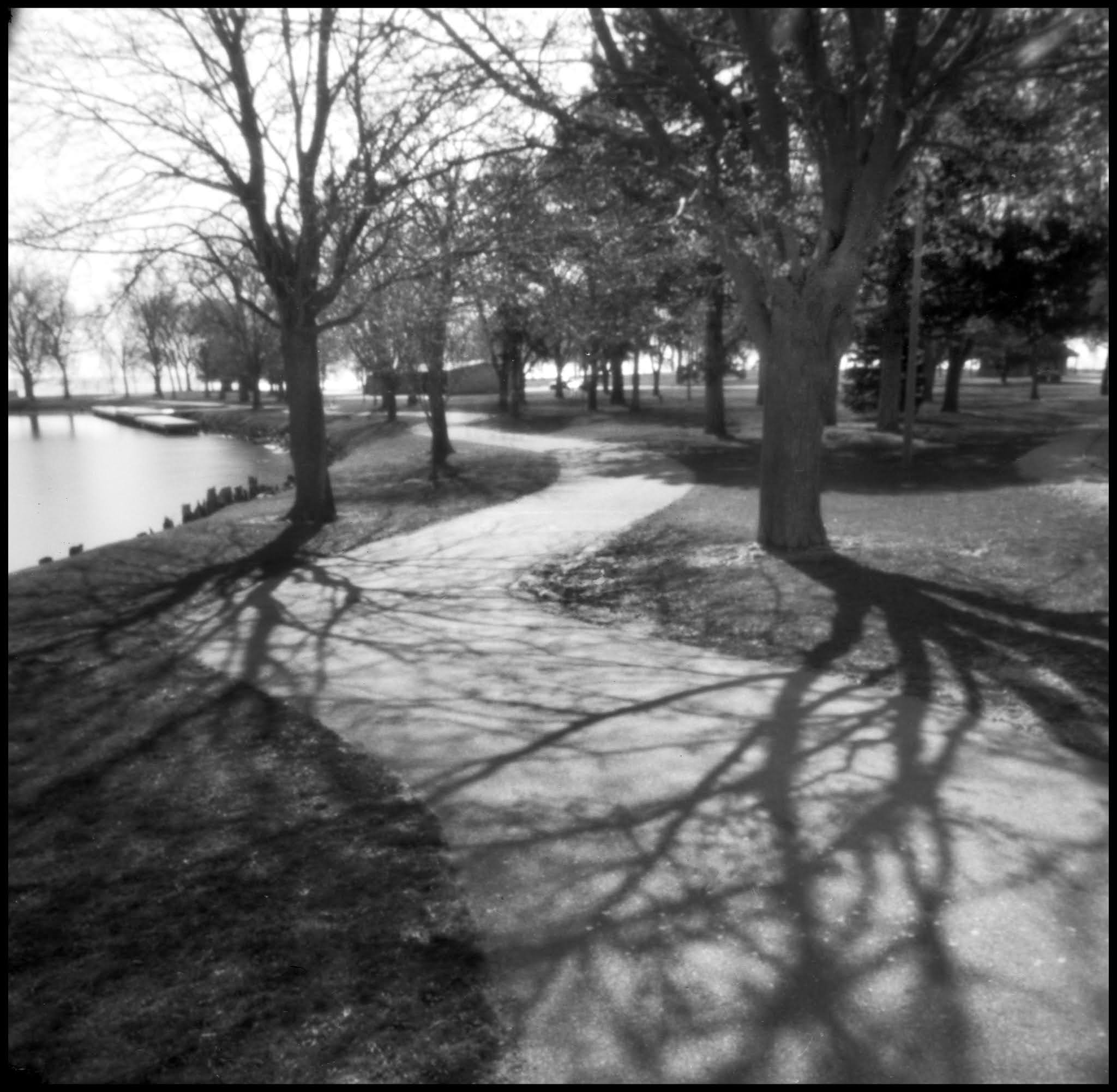
I must have learned this lesson well, because as I ride my bicycle around Oshkosh, I constantly see examples and think to myself: “Well, there’s an S-curve. That would make a nice composition.” Maybe if I took photographs of them it would help me get over this.

Parks are a common place to look, especially where modern trails have been built among existing mature trees. One way to highlight the curve is to photograph into the low sun so the light is reflecting back toward the camera. Getting a little higher viewpoint helps counter foreshortening and opens up that S, as with this view from the bridge over the inlet to the lagoon in Menomonee Park.


The shadow of the trees in the foreground almost overpowers the curve I’m trying to exploit. The dappled light overlaying the curvy trail makes a more complex, if not as unified, composition.


A little bit of a wavy path makes a ride on a miniature railroad a little more compelling as well as a photograph of the rails. This was the subject of my submission for Worldwide Pinhole Photography Day in 2005, although with a little softer lighting.


Sometimes, as here along straight Merrit Avenue, the winding path is purely a design choice,


Here the curve is just another element decorating the background of the the County Park Free Outdoor Gym.


Sometime, your stereo vision and 3-D brain trick you into thinking something is going to form an S-Curve in two dimensions. This is one where getting higher off the ground would’ve been of help. Ansel Adams had a platform on top his 1942 Pontiac Woody so he could get a higher viewpoint. I wonder if it would help my photography if I got a seven and a half foot tripod, and a collapsible ladder and an electric cargo bike so I could use it.


Like the Snake River, Sawyer Creek reflects the sky to define the shape of the shore line as it meanders through the Evergreen Village Nature Walk, seen here with the benefit of the bridge over it on Westfield Street.


Honey Creek’s path through someone’s suburban back yard is defined by the rocky embankment meant to exert human control over any changes to where it’s going. Again from a bridge, this time on Oakwood Road.


City streets normally don’t provide any of the wavy views, but out here in the suburbs they’re common, more to control the speed of traffic than for any visual appeal. The sidewalks, lawns and streets make multiple parallel curves. Despite the sunny day, I seem to have made this neighborhood look cold and forbidding. How’d that happen? I do occasionally see people outside in these places, but they mostly seem empty and deserted when I ride through them. It is fun to ride fast on the nice new empty streets,


Curvilinear trails are not that unusual through natural environments. This one isn’t a result of the lay of the land. It happens to be where a spur line broke off the main railroad whose right of way was repurposed to make the Wiowash Trail.


I think I went overboard with the sun and shadow so it’s a little hard to see the sharp corners of the boardwalk that make up a variant of the S-curve - the Z. The city apparently feels it’s just as dangerous for bicycles.


These were all done with the 60mm front for the 6x6cm Variable Cuboid - .3mm hand drilled pinhole. I had the front at its maximum rise to try to fake having a higher point of view on most of them. The film is Ilford Delta 100 semi-stand developed in Rodinal 1:100.


Friday, May 14, 2021

My 21st Worldwide Pinhole Photography Day

I find it difficult to do any planning for Worldwide Pinhole Photography Day. I’m one of the people who answers the emails when you send a message to contact@pinholeday.org. When I’m responding to a question prior to Pinhole Day, I always end with: “We’re looking forward to seeing what your part of the world looks like through a pinhole on April 25.” That’s how I think about the assignment, to convey something about your location, the conditions that day, what was going on in your life or a comment on the current state of the world, through the tiny aperture. I can’t really predict a lot of that before it happens, so I’m left with just loading the camera and keeping my eyes open.

I chose Supper Club Shorty. I’ve been studying ultra-wide angle lately. Shorty was the shortest camera I had made up til then. I thought it was extremely wide angle at 35mm from a 6x6cm frame. It was one of two medium format cameras I took when I went abroad in 2017. I haven’t used it since. It’s never had black and white film in it, so I filled it up with Ilford Delta 100.

A notable annual event in our yard is the blossoming of the magnolia. We had a very early spring. In early April we had two days in the 70s F. It bloomed at least two weeks early. Temperatures returned to somewhat more seasonal, so the flowers persisted until Pinhole Day. This has to be pretty early in the morning because the sun is just south of east. I used the ever popular trick of placing the camera in the shadow of a branch to eliminate flare.


The lawn has responded to the temperate weather. I won’t keep up any suspense. This is the picture I’ve submitted. It illustrates what it was like where I live in the world, and the daffodils indicate the time of year and from their profusion on Pinhole Day, the early spring.  My Scotts Classic 20” shares some of the charms and attitude of my pinhole cameras. A little postmodernism with the shadow of the camera doesn’t hurt.


What originally captured my eye in this hallway grouping was the title page of the coverless paperback copy of The Idiot. We once booked a hotel in Munich named the Prinz Myshkin Parkhotel. The owner had started a vegetarian restaurant first, and everyone told him he was an idiot to try it in Munich, so he named it after that title character. I took my copy from college along to read on the trip. I put it on my night stand when we got home and never finished it. The cats knocked it off. Sarah found it the other day. Spenser has the irritating habit of chemically identifying his territory, so we usually keep the doors closed to Sarah’s Studio and Andy’s room. I opened the doors to get the exposure down to 25 minutes and sat on the bed to keep an eye out for Spenser. I got involved in the submissions to the WPPD gallery and missed him when he went by just before the end of the exposure. I caught him before he created an incident.


The little faux greenhouse that’s been in various places in our backyard for years, with some fearsome looking rose branches in the foreground. Pretty sharp, eh?


I like the relief graphic of the leaf decomposing and I’m a sucker for raking light.


An iron urn on the old sewing machine base waiting a new assignment.


The house framed by the magnolia as recommended by a Kodak pamphlet I once read on how to take better pictures. Incidentally, no rising front on Supper Club Shorty.


The magnolia with raking light later in the afternoon.

...

I was pretty confident that one of these would work out and had made an insurance exposure in the camera Sarah was using. I was pretty sure I was going submit the lawnmower. I spent the rest of the day cooking and talking with Andy and Kristin over FaceTime.

Supper Club Shorty has a .27mm pinhole 35mm from a 6x6cm frame. Ilford Delta 100 semi stand developed in Rodinal 1:100.


Tuesday, May 11, 2021

Before f295: Making a Pinhole video from 2001

 In 2001, I was asked to produce a narrated PowerPoint show to be placed on a CD which would be distributed to possible donors to a capital campaign to refurbish the University’s Stadium to become a city Sports Center. Handing out CD’s was the latest new thing in Public Relations. Being an up-to-date Audio-Visual professional I thought it would be much cooler to do live location interviews with the movers and shakers involved and put it as an auto-play video on the CD. I pitched the idea and they took me up on it. The problem was, I had only edited digital video once before with a utility editor that came with a Pinnacle video capture card and hadn’t edited video with tape for about five years. The video producer who worked for me was allergic to digital methods (he eventually learned to use iMovie). I had to learn to produce digital videos from start to finish. Final Cut Pro had only been released about a year before and they had spectacular educational deals for what was the premier professional editing software. I thought an instructional piece on drilling a pinhole might be useful and a good exercise to learn the digital workflow.

I found the file recently while searching for something else.

It's really low res. The file I found was already compressed severely for delivery on the internet. At the time I had dial-up at home. We had an at-the-time-wicked-fast T1 1.544 Mbps pipe at the university so I was familiar with what people were doing with video technologies that had been astronomically expensive, but were now available with consumer video and a desktop computer (Although at the time I had about the fastest computer with the most RAM of anyone on campus). YouTube was still four years away but the educational and advertising communities had lot of material on-line. It's just under six minutes long, which, again, at the time was kind of an ambitious download.

I shot it on a Sony Hi8 Camcorder which was about the smallest camera at the time. It had a Firewire connection to the computer. I was wearing a cabled Sony Lavalier mic with an XLR jack connected to a special adapter the techs in my department made for the 1/8 inch mini phone jack on the camera.

I'm a little surprised how well I did. What I remember was a long slog of repeated takes in which I flubbed or forgot the text. The script was on a sheet of paper in 18 point type next to the camera. It was shot over two days in my office after everyone else had left. I noticed that I resorted to one technique now common on YouTube but what was then anathema to the video professional - using a dissolve to cover a jumpy edit where I screwed up my lines.

My hair is kind of funny. I was really pissed off at George Bush, Dick Cheney and John Ashcroft about their promotion of what a "Real American" was like and had started growing it back to the ponytail I had from 1972 until 1985. I still have the ponytail.

I remember being amazed by the flexibility, accuracy and ease of editing. I would describe significant point editing with VHS tape but we really don't have the time.

From out of the distant past, coincidentally the first year of Worldwide Pinhole Photography Day, my lesson on drilling a .5mm pinhole.


Friday, May 7, 2021

Veg Noir

When I did a little close-up studio project this winter, I was fixated on using a light background and forgot that I had a remnant of black felt that I could have used for the seamless backdrop. I decided to use it to reprise the exercise in color. It’s bigger than the tabloid sheet of paper I used in that post. It would be easier to keep the edge of the larger backdrop out of the picture so I chose the Variable Cuboid with the wider 60mm front.

What set me off was looking at a tomato very similar to this one as I peeled it and put it into dinner. I went to the market to get a replacement. I’ve been getting the heirloom varieties of tomatoes at the grocery store. They cost more, but they’re tasty and come in several visually interesting varieties.


I also bought several other types and already had cherry tomatoes at home. This was arranged in a pile more suited to the square format of the camera but after I opened the shutter and tiptoed away, it fell and ended up in this arrangement.


Let’s see what else I can find in the kitchen. In it’s youth, this apple was featured in the earlier post. The orange is even older.


A red and green pepper with a bit of parsley in its usual role as a decorative accent.


Paprika and cumin from the natural foods store.


Cauliflower.


Cauliflower with tomatoes.


Lemon and lime.


A summer squash with asparagus on a leaf of red leaf lettuce.


Several weeks later, Sarah exposed half a roll in the Little Black Cube for Worldwide Pinhole Photography Day. I finished the roll later in the week with more veg.

The same summer squash in surprisingly good shape after weeks in the refrigerator, this time with snow peas. I would play with arrangements in the kitchen before taking them up to the backdrop in the hallway. This time I didn’t want to have to recreate it and just did the photograph on the marble table in the kitchen.


Cherry tomatoes hiding in the celery.


A green and a Vidalia onion.


Before Sarah started with the Little Black Cube I did this self-portrait in the sun room reading Scientific American as back up in case something went wrong with the camera I was using for Pinhole Day.


Both the 60mm front for the Variable Cuboid and the Little Black Cube have hand-drilled .3mm pinholes 60mm from 6x6cm frame. Both were loaded with Ektar 100.


Thursday, April 29, 2021

Emergence

We had an exceptionally early spring. Almost three weeks ago there were a couple days with temperatures in the high 70s (F). The flowers noticed. I loaded the Evil Cube with Ektar 100 and stuck it right in the face of the new growth.

Readers Digest used to put a short bon mot at the end of each article, to fill in the space on the page. The only one I remember is “Before the eye can focus...Crocus!”


The magnolia usually blossoms at the end of April and started popping out flowers much earlier. The temperatures returned to be more seasonal, so the flowers persisted and it’s still putting on a pretty good show.


The daffodils weren't far behind,


One of the earliest bloomers in our yard are the Lungworts. These flowers are only about a half inch wide so this is a nearly 1:1 macro photograph.


The wood violets, which add a little purple tint to our lawn, are even smaller.


Chives are always the earliest herbs to return.


More daffodils are on the way.


A daffodil just opening.


Getting intimate with one of the earliest bloomers.


The Evil Cube has a .3mm pinhole 60mm from a 6x6cm negative.


Saturday, April 24, 2021

What is it with the Ultra-wide Angle?

Ultra-wide angle is almost a standard in pinhole photography. Among commercial camera sellers the longest I could find with a 6x6cm image was 32mm (86.3°).The widest was 20mm (113°). I’ve occasionally used cameras as wide as 30mm, but most of the time I use narrower angles of view ranging from still-pretty-darn-wide-angle 35mm to quite long 200mm. Last winter I decided to try to find the attraction in these extremely wide cameras, most of it done with 4x5 negatives at 35mm. When I made the 6x6cm Variable Cuboid, I included a 20mm front as an extreme example and I’ve used it occasionally. I loaded it up and set out to further my study.

One thing I’ve always disliked is the extreme vignetting this close to the pinhole. Mr. Pinhole says the image diameter is only 38mm. Working with these negatives I felt like I was slogging through mud to overcome the exposure gradient from center to edge. Scanned the way I normally do, I got a spot of overexposed sky in the middle of a black ring. The only way I found to manage them was to do a very low contrast scan and then, with constant adjustment of the range, size and intensity of the burning and dodging tools, I locally treated the image until I got a relatively uniform contrast across the frame. I think you’ll notice that there’s still significant vignetting with very dark edges and corners. A lot of people feel this is the best feature of ultra wide angle.

In response to a previous post, Tom Miller told me about a method Eric Renner suggested to manage this. During the camera exposure, he would hold a black dodging tool in front of the pinhole and withdraw it away from the camera to expose the edges more than the center. I’d like to see him do that during a one second exposure.

Wide open spaces can be made to look even more wide open, and particularly deep. Another prized feature of ultra wide angle is that optimal diffraction occurs at a significantly lower f ratio, f100 in this case. That, of course is accompanied by short exposures. Just under a second in this case. There are ripples from the wind in the water, you can see a few rocks under the water at the shore and the textures in the clouds are rendered in particularly realistic detail.

This is facing northeast so it’s not the sun behind the clouds that’s making the bright spot, it’s purely the vignetting, but it does draw your eye to the center, doesn’t it?  The rocks at the bottom are of course underexposed so the contrast is pretty jacked. I don’t think they have that great a difference in brightness, it’s just differences in the angle of reflection between the sky and the camera, exaggerated by the high contrast.


This one is pretty much pointed toward the sun so the sky is mostly over exposed across the frame in order to get any detail on this side of the trees. The exaggerated depth allows these two foreground trees to stand out in front of the general pattern of the other trees in this little park next to the Winnebago Mental Health Institute Museum. 


With the ultra wide angle any deviation from perfectly parallel to the film plane is magnified. I must have been angled slightly to the right because the horizontals are converging toward the left. Tilted very slightly up too. I don’t think there are two truly parallel lines in this. I rotated it to make the top of the door parallel with the top of the picture.


This is really different in color. The new patches of concrete block are grey and the historic wall is kind of a yellowish sepia. Another crooked wall. Again converging toward the left, so the bottom of the wall is angled up from the center, but it’s perfectly compensated for by the plastic pipe coming in from the right!


Putting a white truck in the middle of the composition is not a great way to manage vignetting. When I’m this close to something it’s always surprising to see the picture. I could have reached the bumper from the camera’s position. It’s obviously tilted up quite a bit which makes the verticals so convergent that the tires look like they’re leaning in.


It was a little less tilted for the disk that drives the mixing drum itself and the stack of the big diesel which is only for mixing the cement. I never realized the drum was such an easily interchangeable part.


In Menomonee Park, I thought the view from the pitcher’s rubber would be dramatic. I was surprised to find these giant craters seemingly made by scraping cleats into the infield. Does this have something to do with pitching? Isn’t this a tripping hazard when you’re playing?


The visiting team dugout from the end of the inside. A really utilitarian use of the angle of view to get something in the frame you can’t get any farther away from. Jay Leno always refers to his favorite kind of antique cars: original and unrestored. This is my favorite kind of negative: uncropped and unrotated. With the camera this low, I can get a good look at the viewfinders and the bubble level on top the camera. It looks pretty accurate.


One of the results of all this tonal manipulation is I ended up with some really high contrast images with a quality reminiscent of Bill Brandt’s pinhole work. I wonder if he ended up with that visual style just trying to manage vignetted negatives.


This is an example of what I think of as hey-my-camera-has-a-square-format composition, taking some roughly square shape and putting it into the center of the image. Another interesting accident of pointing is the top of the back and side rails form a line that’s almost parallel to the edge of the frame. 

Another reason ultra wide angle is so prized is that optimal diffraction takes place with a smaller pinhole, ergo it can render smaller features. One might say it was sharper. That is refractionist thinking that needs to be overcome. I admit there is an attraction to an optimally diffracted image. I invite you to zoom in to see how the pinhole renders the chain link on the back rail of the bleachers.


Common advice to artists is to distinguish your work by making it personal. I’m not sure how I can do it at the softball field. Except for Andy’s career in Cub Scout softball, I think I’ve seen three complete softball games in my life, separated by decades. So I put my bicycle at home plate, with some ultra wide pinhole fun with the front wheel.


The 20mm front for the 6x6cm Variable Cuboid has a .20mm Gilder Electron Microscope Aperture. The film is Ilford Delta 100 semi-stand developed in Rodinal 1:100.