Sunday, July 16, 2023

Reinforcing stereotypes

Most people who have only experienced pinhole photography in a junior high school science class, using re-purposed boxes with photo paper negatives, have a common perception of what pinhole photographs are like. Badly exposed, randomly composed, overwhelming motion blur, streaked with light leaks and covered with scratches and fingerprints. 

A common prejudice among pinholers is that good pinhole photographs can't be done with 35mm. A recurring theme here on Pinholica is advocacy of the creative potentional of 35mm pinhole photography. 

But I'm here today to reinforce those stereotypes and prejudices.

While loading another roll of my 40-year old Tri-X, the counter mechanism on the equally antique bulk loader kept pushing open the lid as it wound, exposing the film and probably the top layer of the bulk roll. After destroying about 4 feet of film, I decided to just leave the lid open and load it in the dark. After the cassette was filled with as much film as it would take, I discovered the inner gate wasn't open. This happened once with an earlier roll without visible effect so I just ignored it and eventually forgot about it. In my frustration with the loader I must have closed that gate particularly forcefully because this time it covered the entire roll with many wavy scratches.

Also, once again, after developing some 4x5 sheets a few days before, the little heater in my darkroom was still on and the red LEDs which display the temperature didn't do the film any good while I struggled to load what turned out to be more than 36 exposures.

In addition, I ended up pursuing a project which was somewhat unfamiliar for me - photographing people.

The whole purpose of the square format, 35mm Manic Expression Cube is to freely explore. I'm going to display these with the scratches and slightly fogged negatives. I recently watched an episode of the PBS science series Nova about the brain and perception. The basic theme was that your brain continuously creates a high definition model of your environment based on some pretty poor resolution input and extensively filters things that don't fit its preconceptions or ceases to worry about being a danger. Let's see what your brain does with these pictures.

No compelling project came to mind and the camera sat around for a few days. One afternoon a group of local photographers were getting together for coffee. As is typical of such occasions, cameras were occasionally pointed across the table without warning, including making a very high resolution image of my grizzled face. I might as well make an exposure of the group. As with a previous opportunity with two from this group at the Farmer's Market, they were of course in the dark in front of a brilliant background.


A few days after that was the Photo Walk in Kaukauna organized by PhotoOpp. After walking around taking pictures, everyone congregated on one street corner, occasionally taking pictures of each other. Not my usual thing, but I hadn't thought of anything else for this roll of film, so ought to give it a try with what were probably willing subjects. That thought occurred to me while showing my camera and explaining pinhole to David Hall.


Another photographer curious about pinhole.


John Adams, co-founder of Photo Opp and Giles La Rock from the Fox Valley Photography Group standing right in the street discussing analog photography. It looks like I had captured the great lens of Giles' Hasselblad, but it's just a merger with the car wheel behind him. 


Mark Ferrell, another Photo Opp founder pointing at me with the original Nikkormat he bought in 1968. That might be the other Photo Opp founder Graham Washatka trying to get a look at his digital screen in the sunlight.


 Scientific photographer Almon Benton looking cool with his shades and Leica.


Brandi Grahl flashing me big smile.


A group in conversation on the sidewalk.


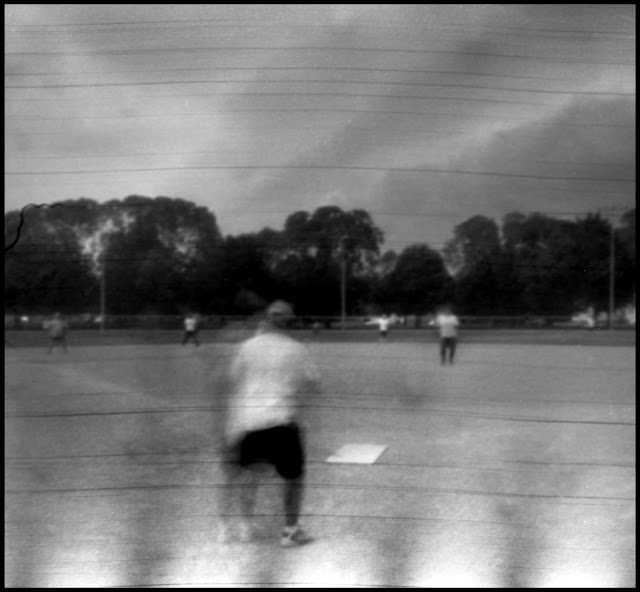
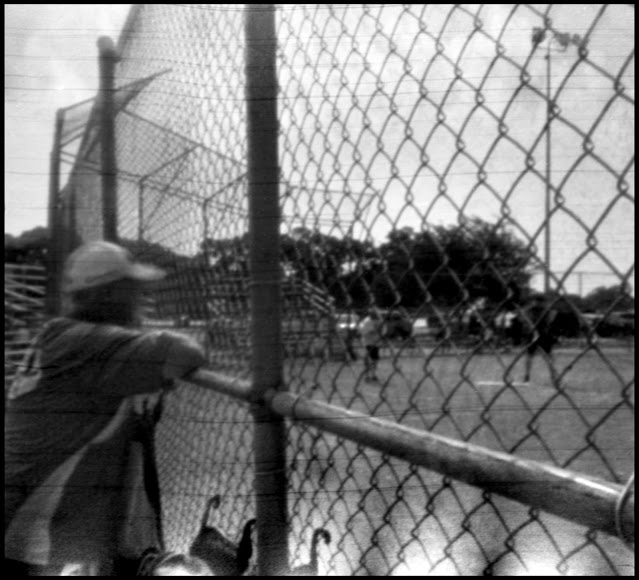
With still no idea for a project, riding past the softball field during a game of the Wednesday morning slow pitch softball league, I wondered what that would look like with my little negatives. 


The view from behind home base.


The guy to the left told me "This is what old men do on Wednesday morning." I replied there are lots of odd things old men do on Wednesday mornings.


Contemplating my project dilemma, I realized I had been pursuing one all along - photographing people. Serendipitously there were two art fairs occurring in Oshkosh that weekend, a likely source for willing subjects. I had done something like that before for the Oshkosh Pleine Air Festival before the pandemic. One of the first jobs for this little camera, in which it gave me a lesson in the slings and arrows of analogue photography as well as the creative potential of those flaws. A picture from that roll was in a juried show in Portugal.

Saturday afternoon was the Alley Art Market behind the 400 block of Main Street, one of my favorite locations for architectural scenes, part of which has recently been covered with a mural.


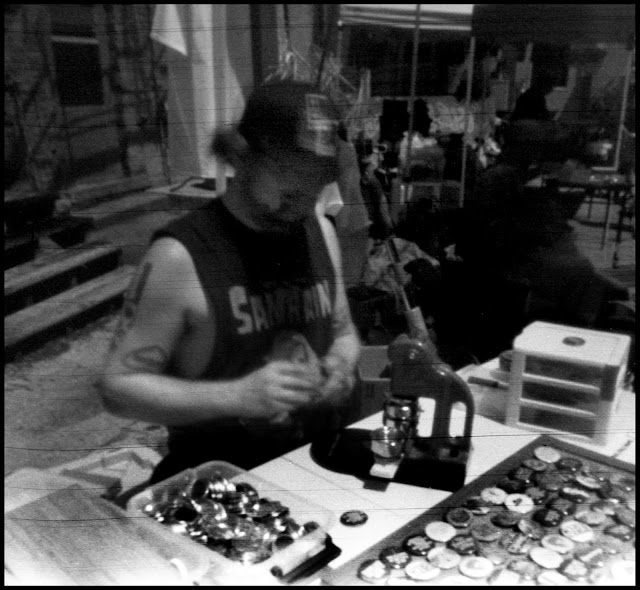
A button maker at work. I told him I did some pieces with classic Badge-a-Minit tools in the 70's and 80's. He had never heard of them. He got his on Amazon.


The band was rockin' but I wasn't sure what particular genre they represented


That was clarified by the t-shirt of the girl selling their merch.


The crowd was primarily young folk. I was the only one there north of thirty except for the parents of one of the people in the band.


Several were inquisitive about my little camera and, like this couple, readily agreed to let me photograph them.


The painter of these swirly compositions insisted on a dramatic pose. We exchanged business cards. He's doing the same pose on the card.


One of the artists concentrating on a sketch book.


A painter at her easel.


A very fashionable painter under a parasol.


I positioned this t-shirt vendor like this since my son works in Boston and might be interested how far this obscure social media meme had come. Another dramatic pose.


This young woman, who was one of the couple from an earlier photograph, was in a group of four in animated conversation. She watched me frame and adjust the tripod. One by one her companions got up and moved which required me to move and recompose. Eventually she was left alone and again graciously modeled. My only regret about the low resolution and grain is that I couldn't capture the tiny white polka dots on her black dress.


Sunday was The Paine Art Center's Faire on the Green on the street and open corner lot next to the museum. As you can tell by the extra "e," it's a different affair than the one downtown.


My first encounter was with a man playing the hand-made recorders he sells. He was playing along with a prerecorded track with an extraordinary amount of reverb. Gave a real new-agey feel to things.


 A large display of cool doll shoes. We agreed that my size was probably out of her range.


This man was selling carved frog figurines with a notched ridge on their back, which when rubbed with a hollow stick made a convincing "ribbit."


Tubular stuffed animals sewn out of shiny material.


I made a point to look for the photographers. This was the only one who was exclusively selling photography.


The last time I was at this event was sometime in the '90s. I remember it as full of framed canvases, prints and pottery with the artists often working on something while the crowd watched.  This woman with the sketchbook in her lap was the only one I saw working on anything.


Otherwise, it seemed more like a craft faire, although some of the offerings, such as these sugar-free confections were quite creative.


After visiting the Rodin exhibit at the Paine a few days ago with many of the dark bronze pieces silhouetted against a window, I was particularly taken by these little bronzes in the light reflected on the glass shelves. The artist hadn't been to see the Rodin sculptures yet.


Only one other exhibit included photography. She told me that she was aware that pinhole photography was having a popular resurgence. Under the tent, the exposure was twelve seconds. I told her to imagine she was posing for Van Dyke. That seems to have worked.


A jewelery maker who teaches K-8 Art in the Appleton School District who had done a pinhole unit in the past. Also understood my direction to act like she was posing for Van Dyke (although I was actually thinking of Holbein at the time).


Appropriately for a "Faire," the band was an traditional Celtic group. I could get right in front of them since no one was boogying in the street.


What I noticed walking by this vendor of fresh fruit popsicles was the composition made by the trailer, figure, umbrella and displays in front of him. Nailed the framing exactly as I'd hoped. Maybe there's a lesson in that.


Just outside the limits of the faire, two young entrepreneurs selling bottled water.


Since he was in the group that started this whole thing by taking that detailed picture of my vintage face, I'll end with famous aviation photographer Jim Koepnik showing his Sigma glass.


If this is the only pinhole photography you've seen lately, please take a look at some of my last few posts to get another conception of what pinhole can be.

I did learn a lot about what I can get away with in public photographing humans that I'll be able to put to use. The composition of most of these was a little off probably because people were waiting for me to make the exposure and I rushed it. Have to watch that. There's Art in the Park in Appleton and the Experimental Aircraft Association in the next few weeks that should be full of willing subjects.

Before loading the Manic Expression Cube again, I'm going to have a project already in mind. When loading more of the old Tri-X, I'm just going to pull it out of the loader, measuring it against my arm like one of Cinderella's seamstresses and roll it into the cassette with my bare hands.

The Manic Expression Cube has a .17mm hand-drilled pinhole on an adjustable rising front with 7mm of travel, 24mm from a 24x24mm frame. The venerable Tri-X was semi-stand developed in Rodinal 1:100.

Monday, July 10, 2023

Life is short, Large Format Photography is long

In our last episode of Large Format Antique Film Pinhole Photography, my antique changing bag had proved unreliable. The film had to be changed in the darkroom. On any venture out to use it, there would only be one frame available. I vowed to do just that. 

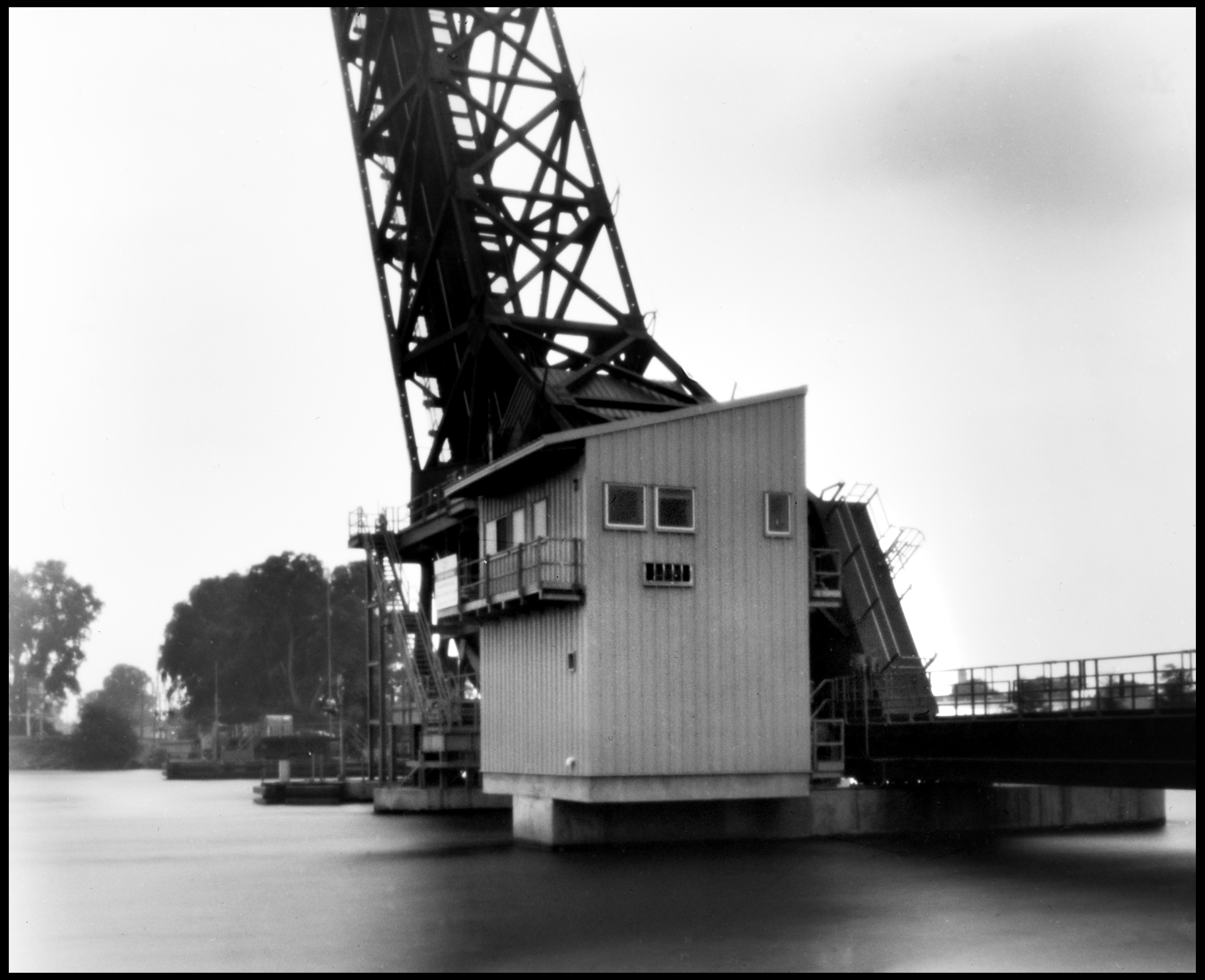
Starting with the 4x5 Pinhole Lab Camera's changeable film plane at 90mm, I went to the Fox Valley Photography Group's meeting early and captured the bridge tender's house of the Veterans Memorial Bridge. It's by the side of the channel instead of on the bridge itself since it's a lift, not a draw, bridge. The Lawe Street bridge in the right background was featured in my Photo Walk roll that took place across the main channel of the river a month later.


Staying at 90mm. We bought a monstera deliciosa for the fern stand on the lanai. The design of the spreading stems looked interesting in the late sun. I've mentioned my penchant for using business reply envelopes as reflectors to provide fill light in sunlit scenes. It doesn't take much of a breeze to introduce one into the scene as though Man Ray showed up in the middle of one of Paul Strand's exposures.


Switched the film plane to 60mm. The corner of this sheet was in the same slot with the sheet in front of it and the emulsion stuck to the base side of that sheet, the first time that's happened since Basic Photography Class with open-lab, metal spiral reels. Ergo, cropped a bit at the top and the right, missing the feeling of being under the canopy I was going for.


Remaining at 60mm. Regular readers will remember me complaining about the Chief Oshkosh Monument in Menomonee Park. They finally installed six, very prominent, new bronze displays explaining about the real historical figure, who was quite a guy, and the racist motives of the people who made the original monument. A real emotional visit now. It reminds me of the Martin Luther King Memorial in Washington.


The peonies bloomed explosively and overwhelmed their stems.  Decided to use a little resin column to pose a bunch in the dappled light. Reloaded and switched back to 90mm.


Out again with the film in the 60mm slot. The bridge tender's house on the Wisconsin/Ohio Street bridge in Oshkosh.


Changed to the 38mm, 121° setting for the film plane that hadn't been used yet. When I didn't have a particular destination in mind, I would inevitably start at Menomonee Park. I couldn't pass up this young woman playing a harp with her companion in a long flowing dress reclining on the blanket beside her. With the extreme wide angle I had to get much closer than it appears here. Unfortunately at some time before or after that exposure, the shutter was briefly opened while it was moving with the sun being drawn across the now heavily exposed negative. Fortunately this month's theme for the Fox Valley Photography Group's challenge is Light Painting. I couldn't really think of anything for the topic and this just fell in my lap. Took some doing to get this misty image from the very dense negative.


With the 38mm film plane again. We got another monstera deliciosa to fill out the fern stand.


Remember most of these were done on separate bike rides. Frustrated by the slow progress, one day I was looking at the changing bag wondering how to attach some elastic to the sleeves. Noticing a little cracking of the rubber by the zipper on the inner bag, I put it over my head and discovered many glowing rivulets where the lining had cracked. It had nothing to do with the sleeves. The bag itself clearly wasn't light tight. I ordered a new Paterson changing bag so I could continue using my box of free film.


I changed the film in the new bag on a picnic table by the shore, but kept it at the 60mm film plane. Another scene I'd done before, but in a different season,


I waited to change the film until I found another scene to photograph. I have been working on a series of the bridge tender's houses on the draw bridges on the Fox. Since I had photographed the Canadian National Railroad bridge numerous times, I knew it called for a narrower angle to just feature the little building. It was great to change the film, and with the Pinhole Lab Camera, also change the film plane back to almost normal at 120mm with the more appropriate .45mm pinholes.


Taking advantage of the easy changing at home, I switched the film plane and pinholes back to the 60mm and .28mm pinholes. Before I could go out again, the low sun nicely modeled all the plants and bird houses on the baker's rack. 


I refreshed the supply in the changing bag and left the 60mm film plane in place. It was too hot to wear a backpack, so I set out with just the one picture available for what looked like an active sky. It turned out to be too active. I grabbed the first available vantage point at the south end of Miller's Bay. Got within two blocks of home before it started raining. Camera just barely got damp.


The next day was cooler. I again left the film plane at 60mm and went out with the changing bag. In my recent piece going around the Menomonee Park lagoon, I realized I hadn't gone completely around it so here is the western shore to complete that circumnavigation.


Again the most interesting sky was toward the north, so I went for the sweeping curve of the beach.  Changed film at a picnic table staying with the 60mm setting. While extending the tripod, this dude about my age came and started sifting through the pebbles on the beach. I asked if he minded being in my foreground. He told me he likes to sort through the rocks on the shore, identify what kind of mineral they are and based on the extent of how they've been smoothed by the river, speculate where they came from and how they got here.


Reloaded and stayed at 60mm for my next planned subject, the bridgetender's house on the Main Street Bridge.


Waited until my next stop to change film and switched to the 120mm distance. The bridgetender's house project wouldn't be complete without documenting that there are two houses on the Wisconsin-Ohio Street Bridge.


On my way from Main Street I had seen this composition of walls and ladders. Reloaded and switched to 90mm and went back for it.


Large format photography is certainly slower than roll film. Although, using my Pinhole Lab Camera takes about as much time as getting a professional field camera out of the case and onto a tripod, even taking into account changing the film every time in the changing bag. 

The big negatives don't really seem sharper. Looking at these at full resolution isn't that much different than my smaller negatives, but at full screen they do have a realism about them I can't quite put my finger on. The complete lack of grain may have something to do with that.

The extra film available keeps overexposed areas from really blooming and softening edges. In the Chief Oshkosh picture, the side I wanted to get was totally backlit by the full sun. Exposed for the shadows, the massively overexposed sky didn't spread or diffract all over the foreground. 

There also seems to be an extended grey scale, which may be a feature of the Plus-X and not necessarily to do with the large format.

The Paterson Changing bag with it's very tight, double elastic sleeves takes some getting use to. You first put your hand through the the end of the sleeve and then push your hand through the second opening on an inner sleeve creating two separate seals. That elastic will probably get a little looser with use so it will be easier to get my arms in. There are seventy more sheets of the Plus-X to investigate further and I finally got my two 500ml bottles of Rodinal which had been back-ordered since March.

The 4x5 Pinhole Lab Camera has slots for the film plane at 38, 60, 90, and 120mm. The pinholes in separate mounts can be changed as appropriate.  The forty-year old Plus-X was semistand developed in the last few drops of the vintage Rodinal I have been using recently, diluted 1:100.


Sunday, July 2, 2023

Walkin' in Kaukauna

I enjoyed the Photo Walk organized by Photo Opp last spring, including interacting with a lot of other film photographers. Last week another occurred in downtown Kaukauna, which I regularly drive through on my way to the Fox Valley Photography Group's monthly get-togethers. It took place in the early evening with the low sun filtered through the remains of a three-day air quality alert. The rather large group started at WI Creative Studio, which hosted the event, on the 100 block of Second Street, but became increasing more dispersed as we proceeded. I ended up mostly on my own, but it was fun to come around a corner occasionally, find a group and have a brief chat.

Across the street on the illuminated north side is this empty storefront with a bare metal grid which formerly held an awning.


The Look Back in Time antique store with it's attention getting window. On that Photo Walk in March, I kept getting distracted interacting with the other photographers and did three double exposures. The worst error this time was this one, done while in conversation and with two cameras pointed at me as well, using the rising pinhole instead of the one on the axis.


The Fox is divided into three channels through downtown Kaukauna. The first on this side feeds the Kaukauna City Hydro Plant and is crossed by a footbridge with a small park at this end.


At my direction, Photo Opp co-founder John Adams standing on a concrete bench pointing his TLR at me. He said he accidentally pressed the shutter during my exposure.


On the island between the hydro channel and the main channel is the original location of the Kaukauna Public Library, now located in a renovated factory on a different island between the main channel and the lock channel.


A lot of the buildings along the old industrial shores of the river have been renovated, but this one with the curious fenestration is still waiting it's turn.


A bare birch along the main river channel glowing in the evening sun.


A walking trail goes under the Lawe Street Bridge with these gothic arched windows matching the middle of the bridge supports.


A stairway that goes to the river level and it's gate cast long shadows into the tunnel.


Coming out of the tunnel, from three blocks away, I could see 313 Dodge nicely modeled in the evening light. By the time I got there, the sides were now shaded and the patios on both sides were full of diners. I set up between them in a parking space occupied by a motorcycle to get the front of the building still illuminated by the raking light. None of the patrons even looked up.


The retaining wall with buttresses against the hillside reminded me of Margaret Bourke-White's Fort Peck Dam.


That led me to walk back all the way to the Kaukauna Dam and the rocky Fox.


Later, everyone converged on one street corner (in the sun, go figure). Very extraordinary to see this large group standing around wielding cameras including a Rolleicord, a Leica, a Nikon F2 and a Nikkormat, a Hasselblad, an SX-70 and of course several serious DSLRs and Sony A7s, occasionally taking photographs of each other. I actually got in on the action, but that will have to wait for a significant bit of manic expression.

All done with The Little Mutant, .27mm hand-drilled pinholes on the axis and 13mm above it, 45mm from a 6x6cm frame. The film is Kentmere 100 semi-stand developed in Cafennol.


Tuesday, June 20, 2023

World Stereoscopy Day '23: A Garden of Guitars

World Stereoscopy Day is June 21st. I had planned to place several solargraph stereo pairs around on the winter solstice for a blog post to be done when the sun stopped moving north. I couldn't think of any great places I could affix them and kind of forgot about it. Recently there have been many reminders by the solargraph community that the traditional time to harvest your images are on the solstices. That reminded me that I only had a couple days if I were going to do a post on Stereoscopy Day.

The least I could do was expose a roll of film in the 45mm 6x6cm 120 Stereo Populist. What could I do to make six stereographs? Taking inspiration from the organization behind the day's celebration, and the coincidental match to the number of guitars in our house, I thought of taking them out in the sunny garden, which also provided a nice alliterative title. They would stand out well as foreground objects in front of the vegetation, which always has surprising random depth in stereo.

There are several ways to present stereo pairs for viewing. I'm going to use two in this post. 

The next three paragraphs from last year's Stereoscopy Day Blog, with updated links.

First is the most natural method, cross-eyed viewing, with the left view on the right and vice versa. You cross your eyes to make a double image. As the left and the right sides of the pair overlap in the middle, they fuse into stereo and depth is revealed. Note that you still see three pictures. It's the one in the middle that's 3D. That may seem unnatural to you, but they're just scanned (or printed) as they appear together on the negatives with no other manipulation or equipment. It does take some learning to view them. I created an exercise with simplified graphics at this link and have been told it does make it easier to learn.

The second is with anaglyphs, where the left and right views are rendered in red and cyan and overlaid on top of each other. Viewing through a red lens on the left eye and a cyan one on the right eye tricks the brain into calculating the depth. You of course need an appropriate pair of spectacles.

 If you want to play along and you can do parallel viewing or if you've got a lorgnette, Brian May's Owl, Google Cardboard or an Oculus rift, here's a link to a PDF with the pictures set up for stereo viewers, in the same order they're in the blog. If you've got a regular Holmes Stereocard Viewer, if printed at 100% they should be the right size.

About the turn of the millenium, I was trying to get back into playing the guitar after 25 years or so of never touching it. I kept entering sweepstakes giving away electric guitars so Andy and Sarah got me this Fender American Standard Telecaster for my birthday, on which I had the bridge pickup replaced with a Seymour Duncan Hot Rail (like Bruce Springsteen although I didn't know that at the time). Our friend the guitar salesman who installed it warned me I'd never get a truly clean sound out of it.


When I collided with a Corvair trying to get a girl to the dorm before hours (look it up, kids), she put her knee through my brother's Alvarez nylon-string acoustic which he had abandoned after he got married. I replaced it with this Alvarez, which is a clone of a Gibson Hummingbird. This was the instrument I played in my folkie career during the Vietnam War.


Everybody has a brush with Gear Acquisition Syndrome. eBay led me to acquire this lovely Ventura clone of an ES-335 with a curiously narrow neck.


A double humbucker solidbody is another major classification ya gotta have. Another eBay Ventura Clone of a Gibson L-6 with the very unusual six-way rotary pickup selector switch.


Sarah gave me the BC Rich Warlock for my 60th birthday. You can understand why that "clean sound" comment didn't concern me. My playing is best described as Punk Surf Metal.


Andy's student Rodriguez which took him halfway through his Bachelor's in Guitar Performance, here with a mind-bending reflection on it's shiny top.


The 120 Stereo Populist has two side by 6x6cm chambers, 45mm from .27mm hand-drilled pinholes on the axes and 10mm above them. The film is Ilford FP4+ semistand developed in caffenol.

As my Pinholic tendencies have gotten more severe, playing these guitars has gotten very rare. When I was rockin' the basement a lot, there were open-mics and jam groups around, but they always specified "acoustic only" which really rubbed me the wrong way. Now I know a drummer who's willing to play with me if I got my calluses to where I could play for more than one song. There's also a bar just a few blocks away that has a regular open-mic/jam night with plenty of amplification. Maybe I just need the right encouragement.