Thursday, July 7, 2022

Philly in the springtime.

Going to give a talk on pinhole for the Fox Valley Photography Meet-up Group, I thought I ought to have a camera loaded with film along. Medium format was too much responsibility for this occasion, but maybe it could work with a 35mm Populist. Philly was up in the rotation.

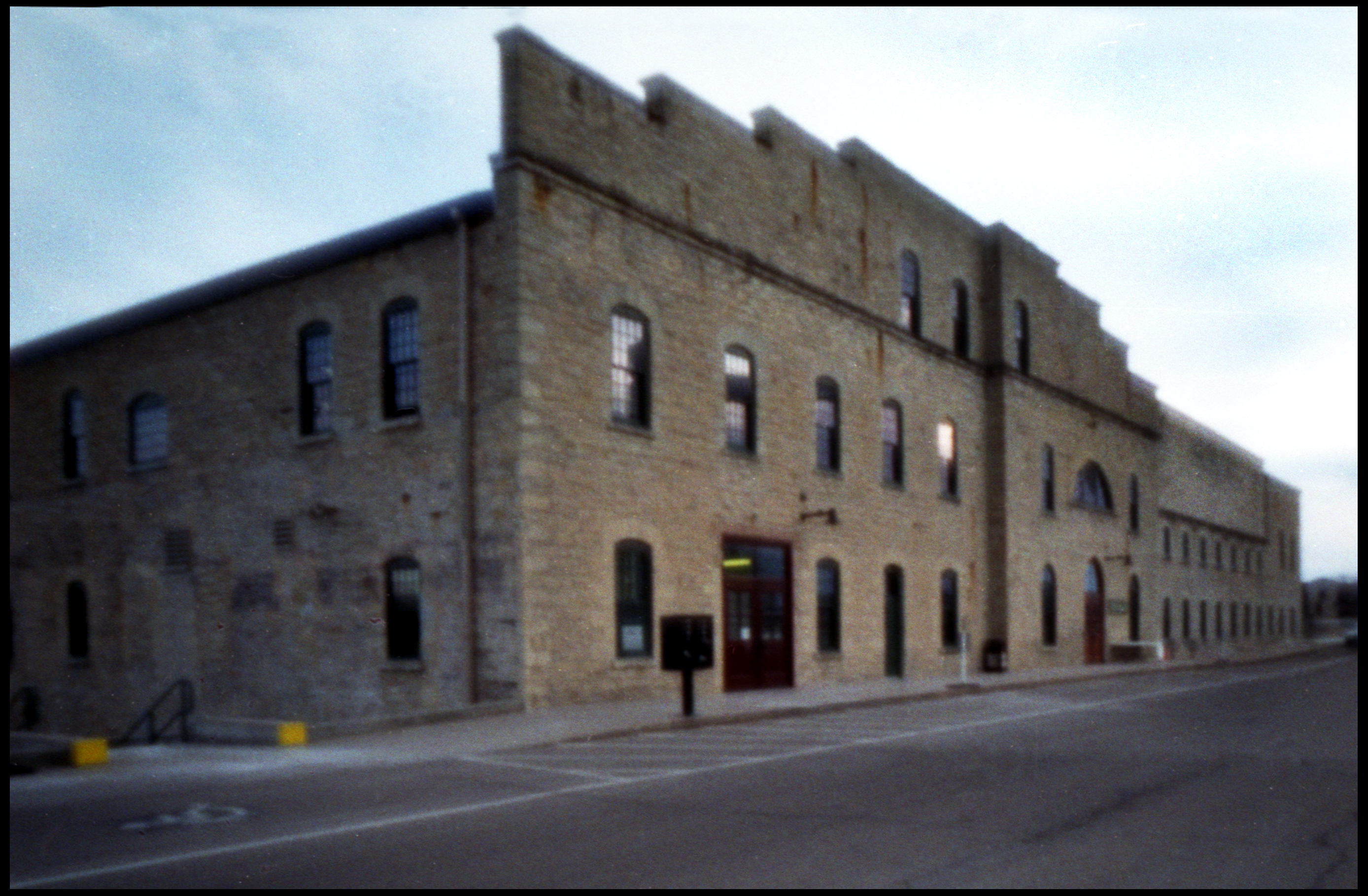
This was just before the equinox. The meeting was at 6pm but I arrived a good bit early to set up and to maybe take a few pictures. It was almost sunset when I got to the Kaukana Public Library, in a restored early 20th century paper mill. 


Right across the street is the lock channel of the Fox River, crossed by the Veterans' Memorial Lift Bridge. The locks were still frozen solid. This is also the location of the workshop I did in April for an adult dry run of the one that starts with middle school kids next week. 


The room had to be totally dark to compensate for a less than new projector, so no pictures. I had Philly with me for the camera-making workshop, but no pictures with it then either.

I don't know how much later it was when I went on a bike ride to look at the ice shoves on Lake Winnebago. It was almost done breaking up.


I wasn't about to walk out on it, but I put the tripod out as far as I could reach.


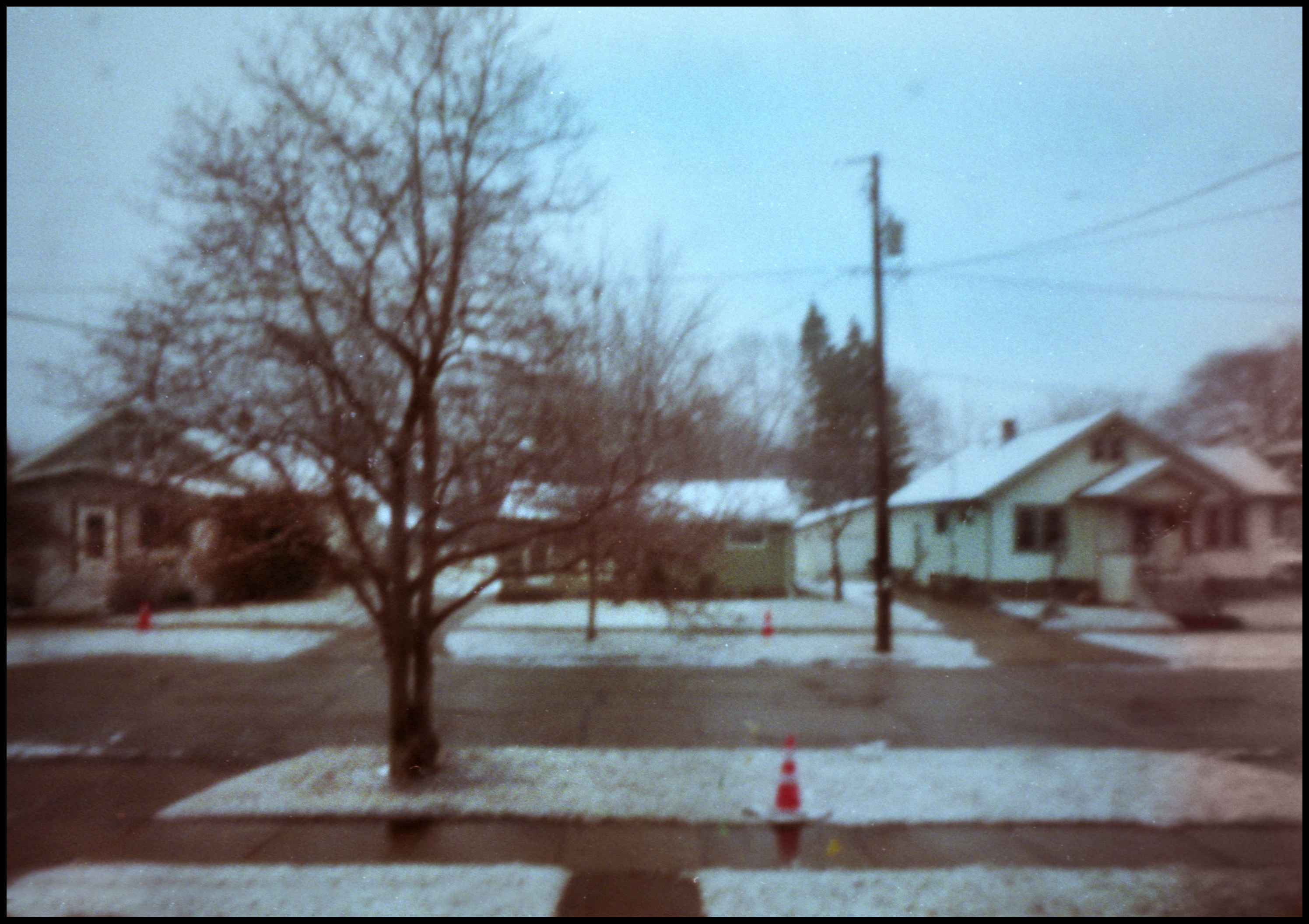
Time-Warner has had a city-licensed cable monopoly forever.  Recently they let TDS lay fiber to compete. We had these little blue and yellow flags that looked like support for Ukraine all over our yards to mark the location of dangerous utilities. Instead of actually digging holes, they drilled them with a giant, loud jet-washer. The trees were nowhere near leafing out and the lawn was brown.


Around here, it was still kind of winter.


 A couple months later they showed up with a flotilla of equipment darting up and down the street.


We were spared much more violence in the front lawn, but our neighbors had quite an event. The guy in the hole manually wrestled the thing they were burying into position.


Brian Ledwell has graciously been making parts with his laser cutter for my museum workshops next week. Pretty cool. Parts already cut out with the adhesive already attached. The kids will still make the outside of the camera. His official office is in my old cave in the underparts of Polk Library. This is his pandemic inspired home office - with a window - where he now works most of the time. I intended to take more pictures but we went to his shop and I left the camera with the shutter open while we were gone.


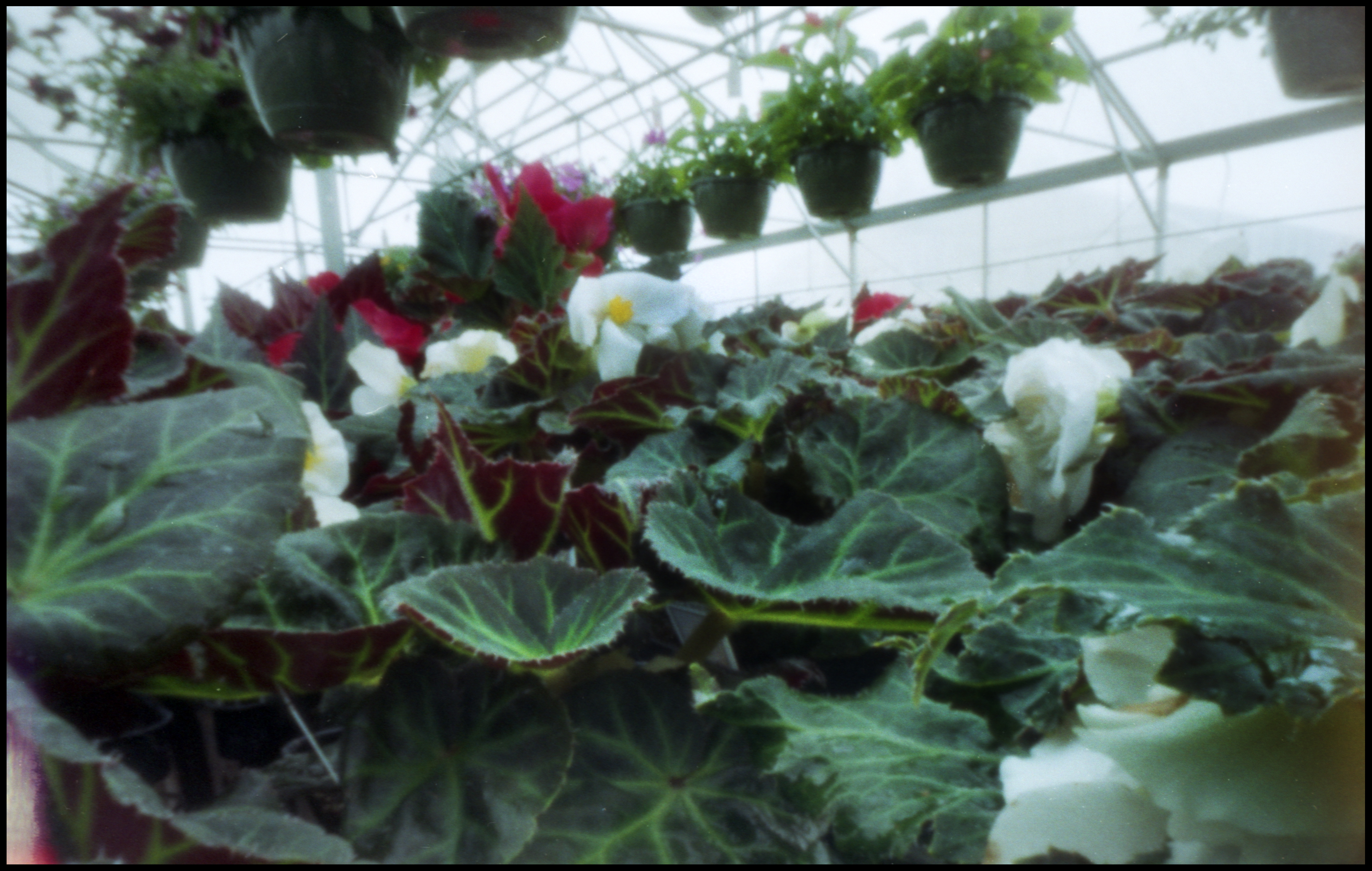
The spring was very late this year. This was probably our first visit to the garden center judging from how small the plants are.


They had lots of things that wouldn't stand a chance outdoors in early May, probably for Mothers' Day.


Some with beautiful blossoms.


Multicolored bunches of blossoms.


Are you getting sick of seeing the Jackson/Oregon St. bridge fixed in an upright position? So are Oshkosh drivers, and especially pedestrians and bicyclists who have to go an extra kilometer to detour around it.


Then finally, after being tempted to blow a roll of 120 color film in the garden, I saw it as an opportunity to finish Philly's roll.

We tried to protect the cabbage plants with these modified pots, but they were only moderately successful against the rabbits.


A coleus next to Elwood's Pond.


The exuberant madness of the daisies


A big drop of water collected on a hosta leaf.


The bench has been taken over by the old roses.


Side-lit lilies of the valley.


An homage to George Davison.


Who spilled bleach on the purple pansies?


Impatiens and coleus around Elwood's Pond. Incidentally those are the new garage doors.


Classic pink peonies.


The peonies weren't really dark purple, but anything else looks even more unnatural.


Coral belles making quite a statement without even blossoming.


Philly has a .15 Gilder Electron Microscope Aperture 24mm from a 24x36 frame.  The film is Kodak Image Pro 100.

Tuesday, June 28, 2022

Creative Color Challenge

 In a post-pandemic attempt to become adept at interacting live with other humans, I've been participating in the Fox Valley Photography Meetup Club of Northeast Wisconsin. One of the features of this, and most other photography groups, is a monthly challenge. The resulting photos are discussed at the meetings. I've been known to give myself a challenge topic before, so I can get into the group activity.

A Hazy Rabbit and the Bars on North Main Street •  Cutting Edge Pinhole Photography •  LUMP East in a local sculpture garden

The challenge this month was creative color.  My film was supposed to come back on Tuesday, but Camera Casino has changed their courier schedule with the lab to only once a week, so my negatives weren't ready for the Wednesday meeting. This didn't happen to anyone else. I was the only one using film. I submitted an older photograph that I thought said something about color and also was a sight gag for my light-refracting companions.

We had a full agenda with a presentation. There was a request that each member only submit one photograph for the discussion so it was kind of a Worldwide-Pinhole-Photography-Day-like necessity to pick one favorite. Now that I have the negatives back, which one of these would it have been?

Although I was concerned about the cliche of pretty flowers, I started in the garden. The exuberance of the wild daisies has always appealed to me, especially combined with the dappled light. Even on the calmest days, it's hard to get a second or two when they hold still at the end of their long stalks. At least four other people submitted pictures from the challenge which featured visibly apparent long exposures, and one was even with a pinhole. 


The peonies were putting on their show. This white one was the only one situated where the breeze couldn't get at it.


Trying to outwit the wind is a losing proposition and I could easily use up the whole roll, so I spent the next hour and half in the garden finishing a roll of film that's been in Philly since spring, but that's another story.

Having nothing to do with the creative color challenge, my 80 year old garage doors, whose mechanisms couldn't be repaired because of liability issues, were going to be replaced the next day. It worked out pretty well for my knees, so I guess I can handle it for the garage. It's been about a month now, and I still reach for the handle to close the door when I get out my bicycle.


I'd  better get serious about this challenge. I went out with a couple scenes in mind.

The Jackson/Oregon St. Bridge will be out of commission for several months. I was hoping they had more flashing red lights.


Color is a nebulous concept. Is rust a color? This garage-like structure is sided with COR-TEN steel with which the surface oxidizes in a special way so it prevents additional internal rusting. The style otherwise matches the very modern, grey and rectangular title company to the left.


A much more vintage little building just to the right with an unusual fuschia paint job, unfinished door and window frames, and two different colors of address numbers.


Is brick a color? My intention was to include the empty rust-colored planters which defined a courtyard, but in my obsession with the level camera, the bottom got cropped a little tight. The first block south of the river on Main has more well maintained historical structures before you enter the now-being-redeveloped industrial sawdust district farther south. This building used to be a fashionable clothing and gift shop and is now a photographer's studio.


I was drawn to the green awnings, but now, seeing that bright strip of grass at the bottom and the green covering on one of the basement windows, it kind of has that creative color vibe. I wonder why the one window with shades doesn't have an awning?


All with Ektar 100 in the Evil Cube, .3mm hand-drilled pinholes, on the axis and 15mm above the axis, 6cm from a 6x6cm frame.


Tuesday, June 21, 2022

Celebrating Stereoscopy Day


The Brian May Archive of Stereoscopy has led a movement for June 21st to be established as Stereoscopy Day. When I first heard the date and who was behind it, I thought that's what happens when your lead guitar player is also a solar system astronomer. But it turns out it's when Sir Charles Wheatstone first presented his paper on the stereo effect in 1838. 

Pinhole Photography and Stereoscopy are linked almost at birth. The first mention of someone taking a pinhole photograph is in Sir David Brewster's 1860 book, The Stereoscope. Although I don't think he questioned Wheatstone's precedence, what I remember about reading the book was frequent, sometimes a little snarky, criticism of Wheatstone. He might've been a little miffed that Wheatstone got credit for the date. Brewster also decided pinholes weren't practical and used lenses for his investigations.

In my modest historical collection of articles on pinhole is one in French from 1889 which is illustrated by a stereo pair.

Like pinhole, stereoscopy is as simple as it can be. It's always surprising how little it takes. You just take two images, coplanar and level, with a bit of a distance between them. You can do this at once in a camera that takes two pictures side by side, or one regular camera, moving it over carefully for the second exposure, often known as cha-cha.

I loaded three pinhole cameras - all with 6x6cm formats - a 45mm stereo camera, a 60mm stereo camera (both with 6cm baselines between pinholes) and a regular single chamber camera at 100mm with which I intended to play with cha-cha, both for too close and too far away stereo.

There are several ways to present stereo pairs for viewing. I'm going to use two in this post. 

First is the most natural method, cross-eyed viewing, with the left view on the right and vice versa. You cross your eyes to make a double image. As the left and the right sides of the pair overlap in the middle, they fuse into stereo and depth is revealed. Note that you still see three pictures. It's the one in the middle that's 3D. That may seem unnatural to you, but they're just scanned (or printed) as they appear together on the negatives with no other manipulation or equipment. It does take some learning to view them. I created an exercise with simplified graphics at this link and have been told it does make it easier to learn.

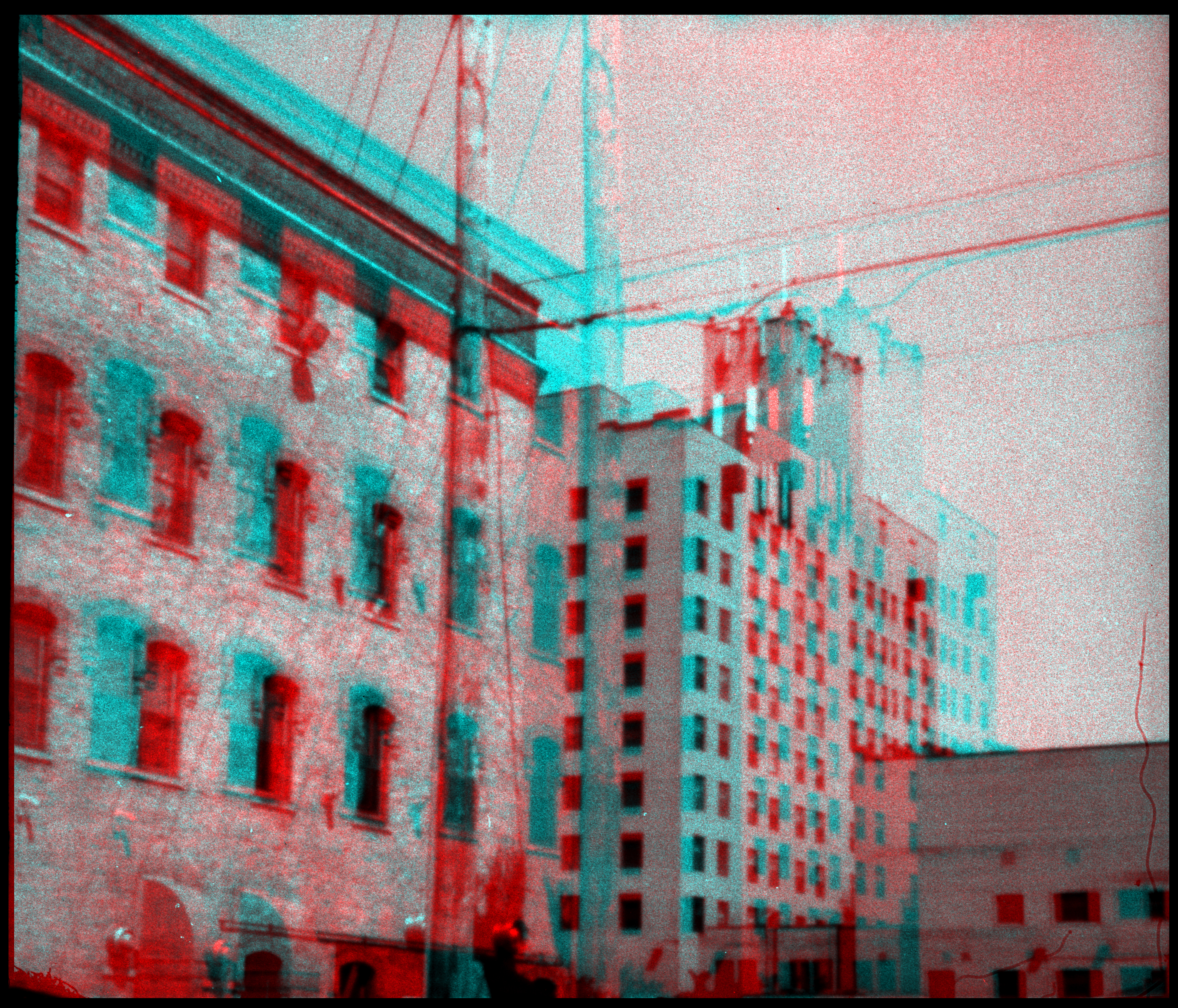
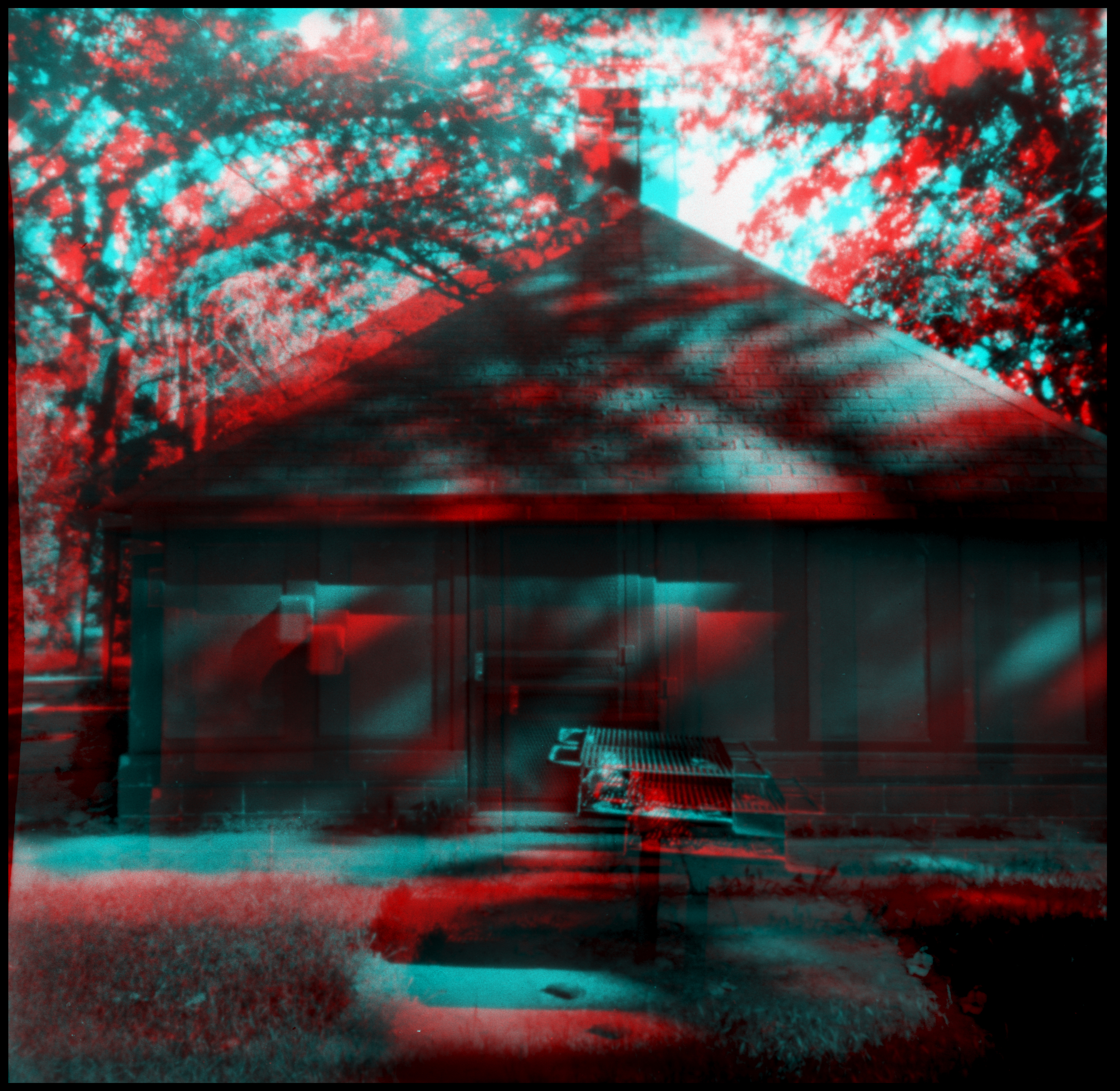
The second is with anaglyphs, where the left and right views are rendered in red and cyan and overlaid on top of each other. Viewing through a red lens on the left eye and a cyan one on the right eye tricks the brain into calculating the depth. You of course need an appropriate pair of spectacles.

 If you want to play along and you've got a lorgnette, Brian May's Owl, Google Cardboard or an Oculus rift, here's a link to a PDF with the pictures set up for stereo viewers, in the same order they're in the blog. If you've got a regular Stereocard Viewer, they should print 7 inches wide.

I started with the 45mm stereo camera with paired 6x6cm images. I built and used it primarily for the Then and Now exhibit at the Oshkosh Public Museum which was suppose to compare (not recreate) archival and contemporary views. Looking through the archives, they had hundreds of stereocards. In addition to pinholes on the axis, it has additional pinholes 10mm above the axis in order to maintain parallel verticals in the buildings I intended to photograph. They were presented with the old picture on one side of a card, and my new interpretation on the other. 

Our giant hosta and the daisies seemed like the kind of a 3 dimensional object that would benefit from stereoscopy. Not the most dramatic in-your-face depth, but it does reward a quiet look around.
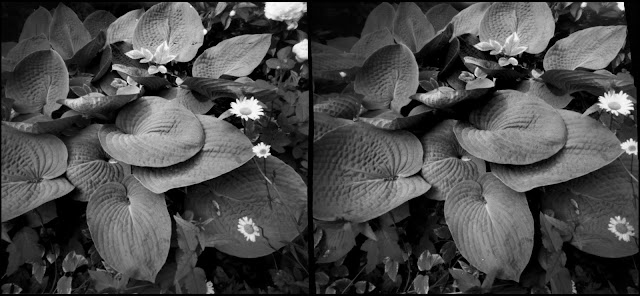


One thing that always impresses me is how stereo viewing can change a composition. The tomato plants seem like a canopy over the bed, but stereo reveals them as individual plants.


After ruining four frames by advancing only one frame before I made my next photo, I wrote 2-4-6-8-10-12 on the counter shutter.

At least I could still recreate that second picture. I used the rising front for the fire escapes from the floor and mezzanine levels of the Grand Opera House.


They're building a new middle school across the street from it so the fate of historic Merril School is uncertain. There's a movement trying to preserve it and they say they've got the interest of a developer to convert it to apartments. I could see having those leaded glass bay windows of the kindergarten in my living room.


To mimic the distance between human eyes, most stereo cameras have a 6cm distance between pinholes, or the focal center of the lenses (how complicated). As you move away from an object, the parallax, which creates the depth, becomes reduced making the stereo effect less noticable. Things also get smaller. That can be countered with a narrow angle of view, but flattening of depth with magnification makes things worse. You can keep the narrow angle of view in order for it to look close up and maintain the illusion of depth by moving the viewpoints looking at the scene farther apart. Some of my favorite stereo views of Comet 67P/Churyumov–Gerasimenko by the Rosetta spacecraft and the Trans-Neptunian Object Arrokoth by New Horizons were done with a telescope with the spacecraft traveling miles between pictures.  For the Arrokoth picture, New Horizons was 28,000 kilometers away for the left frame and 6,600 kilometers for the right and were scaled to match for the stereo view. The stereo effect is extraordinarily robust.

Nearer to home, I loaded the 100mm front for the Variable Cuboid. I had done this for the Then and Now stereocards so I could get whole buildings in and still have a significant 3D effect. To practice my method, I chose the most benign environment possible, the front of my house. I used a long stick of screen molding to keep the camera parallel when I moved it. The baseline is 45cm (three iPhone lengths actually). I somehow neglected to pull the shutter all the way out for one exposure, so it will have to be cropped to a rectangle, but that doesn't matter at all for the stereo effect.


For the grand entrance to the Public Library, I also used the 45cm baseline, this time just eyeballing the parallel line and marking the new location for the tripod legs with pebbles.


Again a 45cm baseline. One trick with a normal photograph is to align foreground distractions with edges of buildings to disguise them. In this case I think this power pole interferes with the depth between the two buildings. A few feet to the right would have made a better stereograph.


If you get too close, the images can be too different for the mind to put them together. With two 6x6cm chambers you can't get any shorter baseline than 6cm, so this limits how close you can work. But with cha-cha, you can make the baseline anything you want. One of my tripods has a slot so you can slide the quick release adapter back and forth horizontally with a scale to measure how much you've moved it. This is from about 30cm away with a baseline of 12mm. I think I can see the depth.


One common perception with stereograms is that instead of continuous depth, the image seems to be made up of a series of planes. One way to counter that effect is to photograph a series of planes, here with a baseline of one of my feet.


You only get six pictures to a roll with stereo. I was upset that I destroyed three pictures on those rolls. I loaded my original 6x6cm stereo camera, 60mm long, which I had made in about 2008. The last time I used it was for the February, 2019 Lunar Eclipse.

It's always nice to be able use a simulated depth cue like the movement of the ferns in the background to exaggerate the stereo effect.


One point perspective is another enhancement.


Minimalism isn't that common in stereography.


Dappled light on another scene without the wow effect but which is worthwhile to look around.


On Worldwide Pinhole Photography Day I always have this snooty reaction to people who only take pinhole photographs on Pinhole Day. I hope I'm not being that guy for the regular stereographers. Thanks for the nudge. Happy Stereoscopy Day!

The 45mm 120 Stereo Populist has hand-drilled .30mm pinholes, one on the axis, and one 10mm above the axis of each chamber. The 60mm Stereo Populist has .30mm Gilder Electron Microscope Apertures. The 100mm front on the Variable Cuboid has a .35mm hand-drilled pinhole on an adjustable rising front. All three cameras were loaded with Arista.edu 100. The first two were semi-stand developed in Caffenol and the last in Rodinal 1:100. The anaglyphs were done with Anaglyph Workshop.